2023-01-13
LLMs can now help you write Python code. There are many available models, so which one should you pick?
We looked at a handful of models and evaluated how well they each generate Python code. To do so, we used Inspect, a Python framework for LLM evaluation, and the DS-1000 dataset, a code generation benchmark for Python data science libraries. For this evaluation, we limited DS-1000 to only the 291 coding problems that involved Pandas.
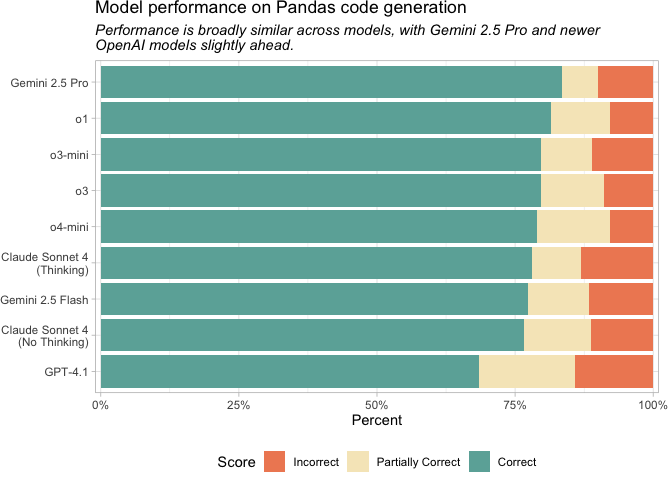
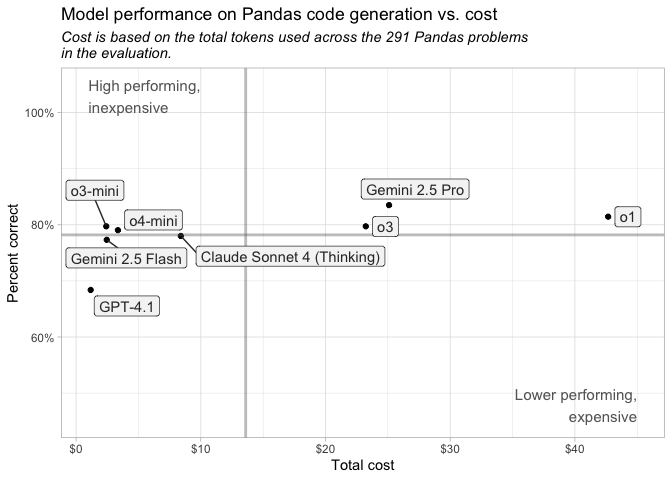
For Pandas coding tasks, we recommend using OpenAI’s o4-mini or o3-mini or Anthropic’s Claude Sonnet 4. The top models all performed very similarly, but their prices vary substantially. o4-mini, o3-mini, and Claude Sonnet 4 are substantially less expensive than Gemini 2.5 Pro, o1, and o3 (see plot below). For Pandas code generation, we expect that the additional cost will not translate to proportionally better results.
Reasoning vs. non-reasoning models
Thinking or reasoning models are LLMs that attempt to solve tasks through structured, step-by-step processing rather than just pattern-matching.
Most of the models we looked at here are reasoning models, or are capable of reasoning. The only models not designed for reasoning are GPT-4.1 and Claude Sonnet 4 with thinking disabled.
Take token usage into account
A token is the fundamental unit of data that an LLM can process (for text processing, a token is approximately a word). Reasoning models, like o3-mini and o4-mini, often generate significantly more output tokens than non-reasoning models. So while some models are inexpensive per token, their actual cost can be higher than expected.
For example, Gemini 2.5 Pro, which performed best in the evaluation, was the second most expensive model. Its per-token cost is only moderately high, but it used substantially more reasoning tokens than other models, bringing its token total usage to 1,797,682.
DS-1000 is a commonly used dataset, so it’s likely that the models were exposed to some or all of these problems during training. This means our results may be inflated compared to performance on more realistic or complex Pandas tasks.
Because of this, the exact accuracy numbers aren’t especially meaningful. Model-to-model comparisons are more informative than absolute performance. Even those comparisons should be interpreted with caution since DS-1000 is such a common benchmark. Ideally, we’d evaluate models on an unseen test set, but building one (especially one as large as DS-1000) is very time-consuming.
We previously evaluated a similar set of models on R coding tasks. That evaluation used a much smaller and more challenging dataset (are, from the vitals package), whereas the 291 DS-1000 Pandas problems are easier and likely appeared in the training data for many models. Because the evaluation datasets differ so much in difficulty and familiarity, you shouldn’t compare performance across the Python and R evaluations. Instead, compare models only within each evaluation.
LLM pricing is typically provided per million tokens. Note that in our analysis, Gemini 2.5 Pro, o1, o3, o3-mini, and o4-mini performed similarly for Python code generation, but Gemini 2.5 Pro, o1, and o3 are more expensive.
| Price per 1 million tokens | ||
|---|---|---|
| Name | Input | Output |
| Gemini 2.5 Pro | $1.25 | $15.00 |
| o1 | $15.00 | $60.00 |
| o3-mini | $1.10 | $4.40 |
| o3 | $10.00 | $40.00 |
| o4-mini | $1.10 | $4.40 |
| Gemini 2.5 Flash | $0.30 | $2.50 |
| Claude Sonnet 4 | $3.00 | $15.00 |
| GPT-4.1 | $2.00 | $8.00 |
This evaluation focused only on Pandas problems. We excluded DS-1000 tasks that did not involve Pandas.
In future work, we plan to evaluate model performance on other common Python data science libraries, including Polars. Anecdotally, we’ve found that models struggle more with Polars code, and we’re interested in testing this formally.
You can see all the code used to evaluate the models here. If you’d like to learn more about LLM evaluation for code generation, see Simon Couch’s series of blog posts and the Inspect website.