Governance, Speed, and Scale: How to Eliminate Enterprise Data Science Bottlenecks with Posit

The 2025 release cycle for Posit introduced exciting changes across the Posit Team suite! Posit Team is the bundle of our most popular professional products: Workbench, Connect, and Package Manager. Across all three, we streamlined the path from development to production, removed barriers between R and Python, and gave IT the robust governance needed to scale safely.
At Gen Re, Matthew’s team hosts Posit Team globally, with 7 instances worldwide to support regulations requiring data to reside in specific countries. Databricks is their data store and compute power. Databricks and Posit work in conjunction as part of Gen Re’s enterprise data architecture to allow for managed and governed access to data in the data lake from a platform data scientists are familiar with — Posit Workbench.
“In the past it took about 30 minutes. As a result, what we’re able to do through Posit and orchestration across our AI services is save about 600 hours per day.” – Chris Engelhardt
Senior Data and AI Operations Manager at Gen R
If you want to nerd out with us about an amazing year, keep reading!
Explore the 2025 updates to Posit Team, including Positron, MCP integration, and enhanced security controls.
Strategic Value for Decision Makers
Our 2025 releases provided leaders with the tools to balance technical innovation with corporate governance and financial oversight.
|
2025 Update |
New Capability |
Organizational Value |
|
Unified data science IDE for Python and R |
Strengthens human-AI collaboration and breaks silos between R and Python teams. |
|
|
Connects AI assistants to internal package repositories. |
Ensures AI-generated code follows compliance standards by using validated packages. |
|
|
Tracks compute consumption by business unit and supports modern hardware. |
Enables accurate internal chargeback models and reduces cloud infrastructure costs. |
|
|
Restricts internal packages to authorized teams. |
Protects proprietary R and Python assets in regulated environments like pharma and finance. |
|
|
Enables Development (Workbench), and Deployment (Connect) within the same Native app, within your Snowflake environment. Instant setup, fully managed. |
Teams become productive in minutes. AI works out of the box. Safety gained through inherited governance. No more ops headaches. |
Data science and research
Many of our 2025 updates focused on supporting both R and Python workflows and reducing the friction between writing code and deploying it.
Unify R and Python Teams in One IDE with Positron: The biggest shift this year is the general availability of Positron, a data science-oriented IDE compatible with both R and Python. For teams that support both languages, Positron simplifies the workspace by supporting both native R and Python execution. The Data Explorer allows you to filter and sort datasets via a UI, then auto-generates the corresponding R, Python, or SQL code to ensure reproducibility.
Context-Aware AI Assistance: The new Positron Assistant integrates deeply with Positron to provide help that understands the specific context of each step of your data analysis. Unlike generic chat tools, Positron Assistant can see your loaded dataframes, variables, and even plots to ground AI code generation and answers in more ground truth. It also connects with the Posit Package Manager Model Context Protocol (MCP) server. This means that Positron Assistant suggests packages that are actually available and approved within your organization rather than hallucinating libraries that IT has blocked.
Expanded AI Choice: Positron Assistant’s “bring your own model” design now supports models provided by Amazon Bedrock and Snowflake Cortex, in addition to the existing Anthropic and GitHub Copilot model providers, as well as the experimental OpenAI and OpenAI-compatible model providers.
Continued expansion of popular Python frameworks: We continue to add support for the tools data scientists already use. Connect has added support for Panel apps, making it easier to publish rich, interactive Python applications alongside Shiny and Quarto content.
In-Database Scoring: Working with large datasets in Snowflake or Databricks is more efficient with the Posit Team’s integrations and the orbital package. This tool translates models into native SQL, allowing you to run predictions directly within a database without moving data back to your local environment.
Curating Effective Data Product Portfolios: The new Usage Metrics Dashboard, available via the Connect Gallery, tracks content visit frequency. Team leaders can use these insights to identify exactly which applications, reports, and APIs hosted in Connect are highly engaging and which unused projects could be retired to reduce maintenance overhead.
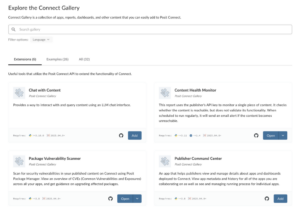
Posit Connect content gallery
Expanded OAuth Ecosystems for Workbench and Connect: We broadened connectivity options across the suite. Connect now supports AWS IAM Roles, Azure OpenAI, and Google Vertex AI, enabling secure access to data and LLMs, with the new ability to use multiple OAuth integrations in a single application. For development, Workbench introduces Custom OAuth as a preview feature, allowing you to configure authentication for a wider range of data sources. These updates build on our robust ecosystem, further recognized by our selection as Databricks Developer Tool Partner of the Year.
Seamless Cloud Deployment: Connect Cloud, our hosted offering, now supports direct publishing from Positron, VS Code, and RStudio, allowing you to deploy R and Python content without leaving your IDE. You can also keep your data products fresh with automated content republishing schedules and create custom URLs to make sharing links with stakeholders more professional.
ACES uses Posit Team and Positron to support its data science group, which oversees more than 1,000 production models across U.S. energy markets.
“Positron stands out as a more robust developer IDE with strong polyglot support, seamlessly handling both R & Python to create a more versatile and productive experience.” – Frank Hull
Director of Data Science & Analytics, ACES
IT
Platform managers gained tools in 2025 to improve observability, enforce finer-grained security policies, and manage infrastructure costs for Posit Team.
Expanded integrations and data access governance: Connect now makes it easier for a single deployed application to securely work across data that lives in multiple systems. With expanded integrations, deployed applications can now securely access multiple external data systems using separate OAuth credentials for each platform, while custom volume mounts let applications running in Kubernetes securely access required external files and directories.
Features for managing multiple teams: Connect offers multiple new governance and access controls to help organizations manage large teams effectively. Admins can now limit which container image different user types can run their content by applying user permission sets to execution environments and restrict which OAuth integrations different teams can use.
Granular Security in Package Management: Package Manager now supports authenticated repositories. You can restrict access to specific repositories using API tokens, which helps protect proprietary internal packages or sensitive data. Additionally, Package Manager introduced Single Sign-On (SSO) authentication via OpenID Connect (OIDC), enabling you to map users and groups from providers such as Okta or Microsoft Entra ID to specific permissions.
Vulnerability Management: To help meet strict compliance standards in sectors such as Finance and Government, Package Manager has added the ability to block packages based on CVSS scores. You can set a minimum severity threshold to automatically block high-risk vulnerabilities. RStudio (also in Workbench) now displays CVE warnings directly in the Packages pane to alert users early in the development process.
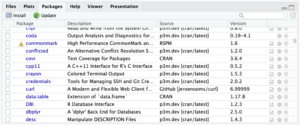
See package vulnerabilities inside Workbench’s Packages pane.
Enhanced Auditing: Workbench now features enhanced audited jobs that can log detailed session history and job outputs to help ensure the validity of each individual analysis. Posit Workbench also added a dedicated Audit Database that captures per-session data, enabling administrators to track usage patterns and ensure compliance.
Richer Observability: Both Workbench and Connect expanded their support for Prometheus metrics to capture real-time data on HTTP traffic and system performance. These updates allow you to identify bottlenecks and tune infrastructure resources based on actual consumption.
Resource Optimization: New session auditing metrics in Chronicle enable you to understand user behavior, including preferred IDEs and Docker images. You can use this data to tune compute profiles and retire unused environments, ensuring that infrastructure configurations align with how your team actually works.
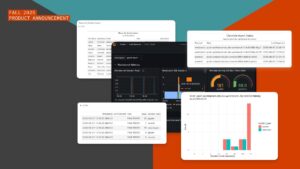
Enhanced metrics available across Posit Team
Infrastructure Flexibility: Package Manager now provides CRAN binary packages for ARM64 Linux distributions, giving teams more choice about where to execute R code.
Streamlined Cloud Infrastructure: The Posit Team Native App on Snowflake reduces administrative overhead and allows scalability by running directly within Snowpark Container Services. This fully managed application handles upgrades and backups automatically while inheriting your existing Snowflake security roles and governance controls. Use Workbench, Connect, and soon, Package Manager – all without leaving Snowflake.
Managed Infrastructure with Enterprise Control: Connect Cloud offers a hosted alternative to on-premise servers that removes the burden of maintenance and upgrades. The new Advanced Plan introduces enterprise-grade security features like Single Sign-On (SSO) and Role-Based Access Control (RBAC). Additionally, you can now define specific memory and CPU limits for applications to manage resource consumption effectively.
In September 2025, Posit signed a Strategic Collaboration Agreement with AWS. The SCA enables enterprises to seamlessly migrate to the cloud, building, running, and leveraging critical data science outcomes. Posit helps customers leverage AWS infrastructure and data systems when using Workbench, Connect, and Package Manager. Posit and AWS will continue developing enhanced integrations with AWS services, including Amazon SageMaker, Amazon Bedrock, Amazon Elastic Kubernetes Service (Amazon EKS), Amazon Simple Storage Service (Amazon S3), and AWS Lambda.
- By adopting Workbench with Amazon SageMaker, TruDiagnostic saved a full year of product development time, cut their cloud infrastructure costs by 60%, and increased both their AI and statistical model training performance tenfold.
- NASA is leveraging a combination of Posit Team and Amazon Web Services (AWS) to provide the insight necessary for strategic workforce planning and dynamic scenario planning.
“The combination of AWS and Posit has transformed our analytics organization from a traditional reporting function into an AI-powered innovation engine.”
– David Meza
Head of Analytics, OCHCO and Branch Chief, People Analytics, NASA
Open source
Our professional products continue to bring the power of open source to the enterprise, and we proudly invest significant revenue in our open-source packages and tools for R and Python. 2025 was an amazing year for our open-source development! Read about that great work and our commitment to the Open Source Pledge here.
The road ahead
Posit’s focus remains on strengthening the partnership between data scientists, IT, and decision makers. Whether your team is writing complex code by hand or leveraging AI agents to accelerate development, we are committed to ensuring those workflows are grounded in reproducibility and trust. In 2026, we will continue to build tools that empower researchers to move quickly, while providing IT and decision-makers with the assurance that their data science infrastructure is robust, responsible, and ready for the future of code-first data science.
We look forward to seeing you virtually and in person throughout 2026. Visit our events page to find ways to connect with the community and us, or set up a call to chat.
posit::conf(2026) is happening in Houston, TX, on September 14-16. We would love to see you there!