2026-03-27 AI Newsletter

This newsletter is a little different. Our web team is in the middle of a website migration, so we had to prepare this newsletter a few weeks in advance! Because we couldn’t predict the news, we wrote up a brief timeline of how Posit has thought about coding agents for data science. Website migrations are ongoing, so we’ll take a break from our usual release cycle and be back on April 24th.
Modern LLM-powered coding agents may feel ubiquitous now, but their history is relatively brief. At Posit, we started experimenting with coding agents or assistants in 2024, but it took a while for our agents to resemble our latest version, Posit Assistant. We’ve gone from caution, skepticism, and purposefully constrained tools to where we are today: a clearer understanding of the risks and an appreciation for solid, really useful tools.
We’ve put together a brief history of agents for data science from our perspective. Before we go into the details, you’ll notice a parallel evolution in the underlying models. As models improve, their usefulness for data and coding tasks goes up and the chance of error goes down. This is why we encourage people to try the best models they have access to and why we tend to only allow (or at least recommend) models we think are capable enough in our agents. There is only so much you can do with the harness, tools, prompting, and skills if the underlying model is prone to hallucination or errors.
Late 2024 – Early experimentation
In October 2024, Winston Chang released Shiny Assistant, which used a chat interface and Shinylive to help you build Shiny apps in the browser. The ability to chat your way to a Shiny app in real time was an incredibly useful development, and at the time felt really novel. You can use Shiny Assistant at gallery.shinyapps.io/assistant/.
The Shiny Assistant announcement post came with a disclaimer:
“All that said, it doesn’t always get things right. Like a human assistant, it’s imperfect: it makes mistakes, it has gaps in its knowledge, and sometimes in the course of trying to solve a problem, it gets stuck on the wrong path.”
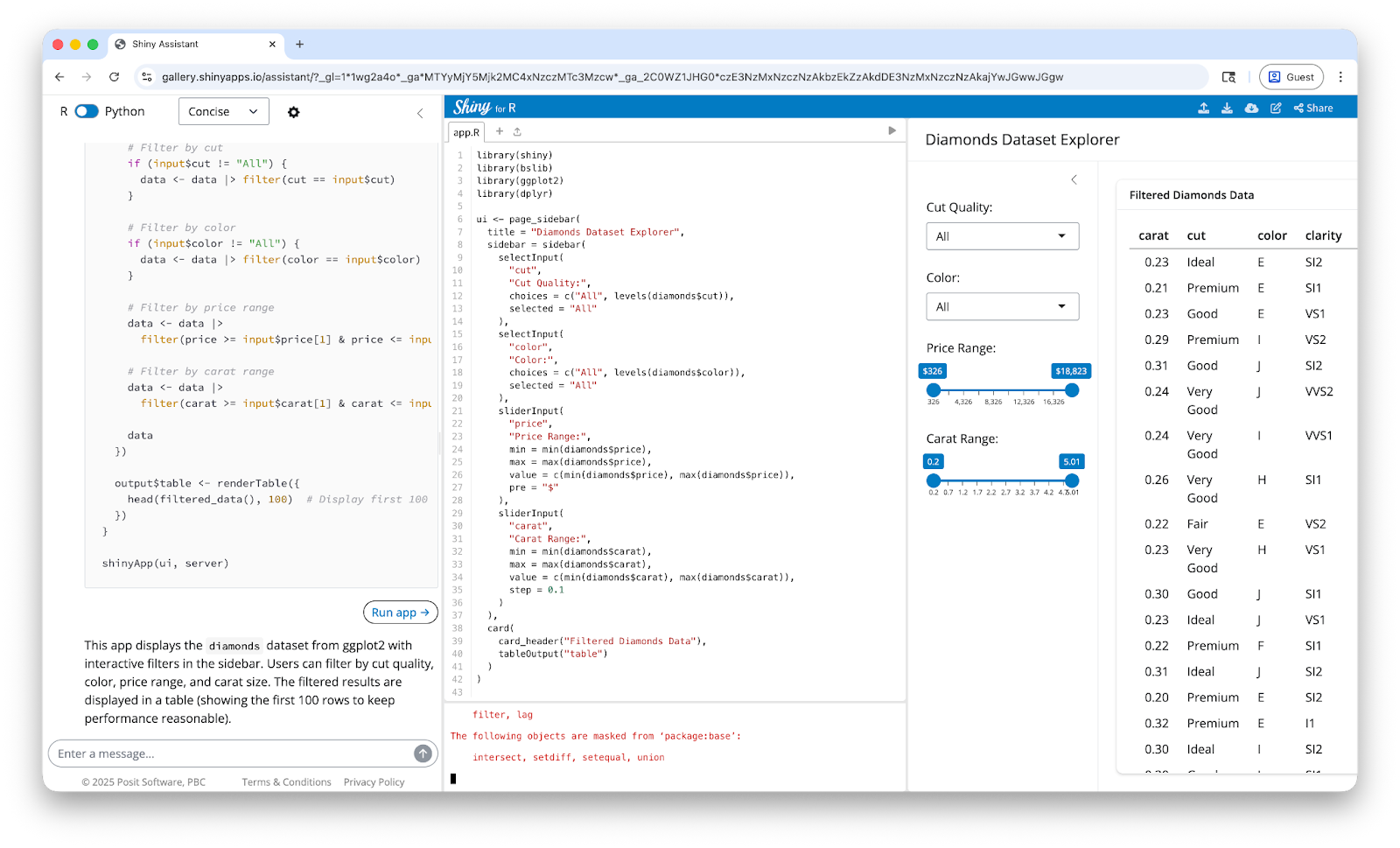
Shiny Assistant (released 2024, screenshot March 2026)
Then, in late 2024, Joe Cheng started showing a demo to a few groups internally at Posit. He had created a shinychat app that provided Claude Sonnet 3.5 with a tool that allowed it to run R code and see the results. The model was prompted to use that tool only a few times before summarizing what it had learned and providing a few suggestions about where to head next (the WEAR loop). Joe found that the tool (later released as Databot) dramatically accelerated exploratory data analysis, but also made many mistakes.
Early 2025 – Better models and coding agents
AI assistance for coding really started to take off in early 2025. In February, Anthropic released Claude Sonnet 3.7, and then Sonnet 4 in May 2025. With each model release, the models made fewer mistakes.
Simultaneously, coding agent harnesses like GitHub Copilot Chat and Claude Code were progressing rapidly. Claude Code (released February 2025) was demonstrating that careful context engineering could lead to much more reliable results in coding agents. Internally, Posit engineers were getting more and more use out of coding agents, despite some initial skepticism. You can read Simon’s thoughts on Claude Code from March 2025 (somehow only a year ago!) here.
At the time, there was a real sense that using these tools could be reckless. Andrej Karpathy coined the term “vibe coding” in February 2025 to describe the practice of letting AI write code without really looking at it or fully understanding it, and there was a decent amount of hand-wringing about the process.
June 2025
As coding agents improved for software engineering, George Stagg saw the same potential for coding agents in data science. As a fork of VS Code, Positron already had many of the foundations of a coding agent built-in from GitHub Copilot Chat. What if that harness could also “see” the data and R/Python output that data scientists were working with in Positron? This was the idea that led to Positron Assistant.
Positron Assistant, a general-purpose coding assistant in Positron, was released in June 2025. Positron Assistant is still in use today.
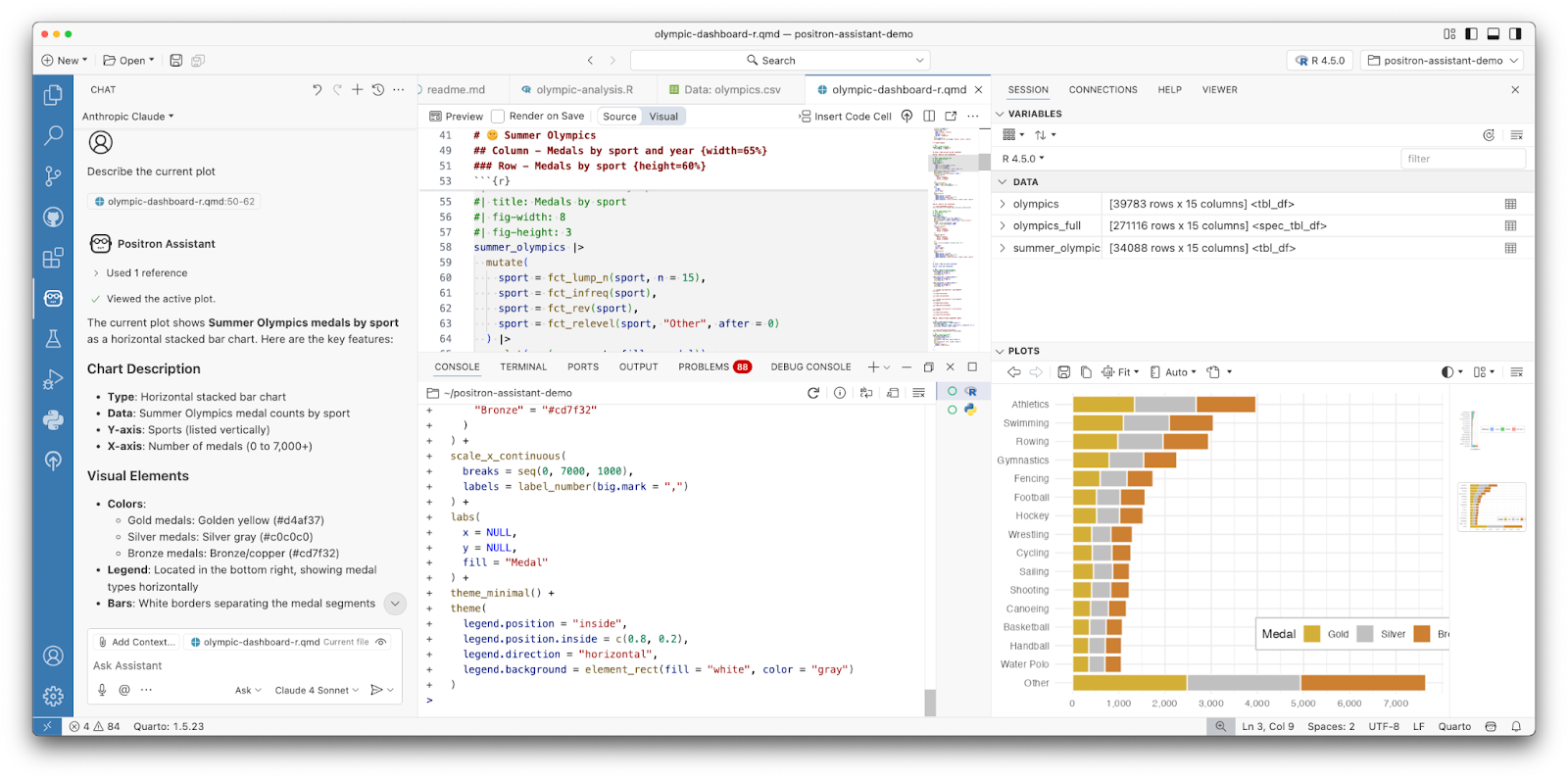
Positron Assistant (June 2025)
Note: despite their similar names, Positron Assistant and Posit Assistant are different assistants with different development histories.
August 2025
We released Databot, the EDA agent Joe started developing in 2024, in Positron. We were excited about the capabilities of Databot, but also relatively worried about the risks, releasing it under several layers of warning: calling it an “experimental research preview” and emphasizing that “it was not a flotation device” (meaning that it was not a substitute for coding or data expertise). Databot is still available in Positron.
Databot was (and is) specialized and interactive by design. It is only really equipped for exploratory data analysis and heavily involves the user, favoring short turns and input over a more autonomous workflow.
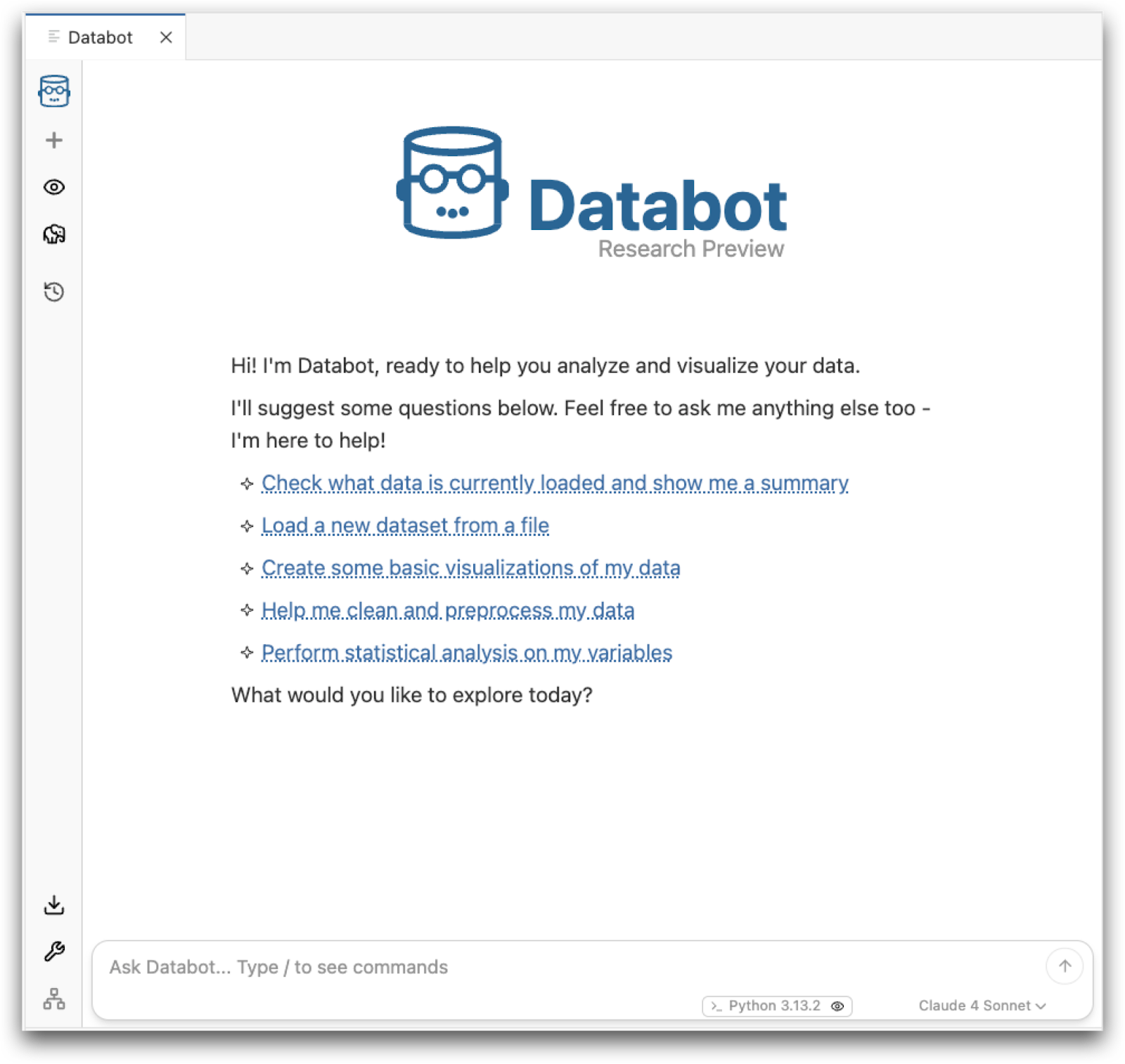
Databot (2025)
Databot was developed and tested with Claude models, and is only available for use with that model family. Sticking with one model family allows us to iterate on the prompting with the confidence that our changes will affect behavior similarly across models. Provided with the same prompting, models from other providers can behave quite differently. Sometimes, those differences mean a capability is lost (like predictably stopping generation after 3 or 4 tool calls) and we think Databot’s risks are too great without this balanced set of behaviors.
As we iterated on Databot and Positron Assistant, we studied how frontier coding agents managed their context windows, provided models with access to information, and handled varying degrees of autonomy. Command line interface (CLI) agents like Claude Code, specifically, became increasingly indispensable for many of our engineers’ workflows. Inspired by those tools, we began work on a next-generation AI assistant for data scientists that integrated the capabilities of Databot and Positron Assistant in a cross-platform harness.
October 2025
The first step was a new full-height “Sidebar” pane, which first made its way into RStudio daily builds starting in October 2025. At this point, as well, the open-source ellmer and chatlas packages (for working with LLMs in R and Python, respectively) and their shared UI shinychat had become solid foundations for AI development.
Simon combined these building blocks into side::kick(), an experimental open source coding agent for RStudio built entirely in R. The harness looked a lot like those of CLI coding agents, with the added benefits of a “real” UI from shinychat and access to objects in the active R session.
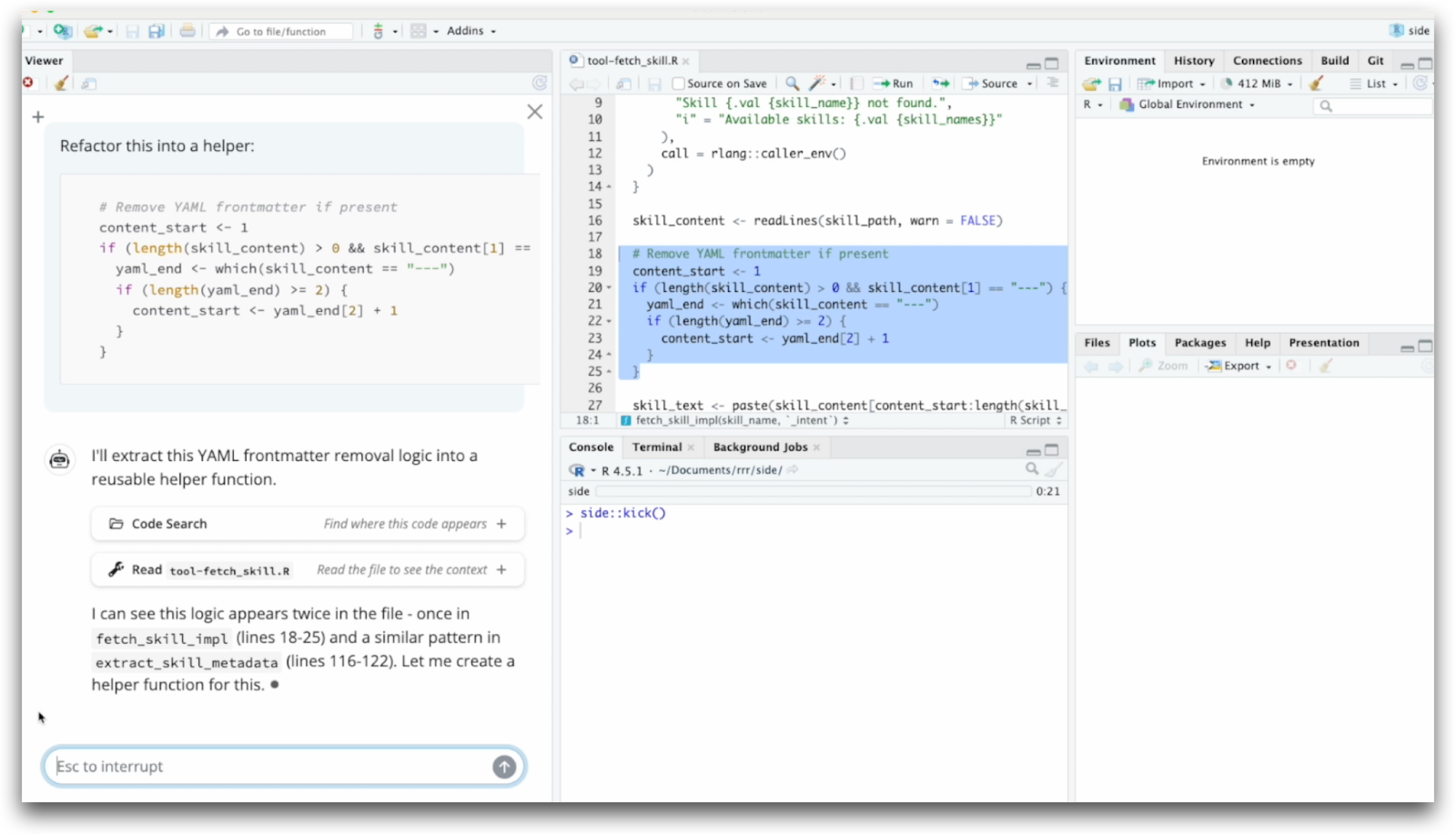
side::kick() (November 2025)
November 2025
In late November 2025, Anthropic released Claude Opus 4.5. Many of us experienced this model as a step change in coding agents’ abilities, including in the early experimental builds of Posit Assistant. This model release confirmed what we’d been inching towards: that models were reaching a point where we could build trustworthy data science agents.
Winter 2026
In January 2026, we launched a private beta of Posit Assistant for RStudio users. A little over a month later, on March 5th, we publicly released Posit Assistant as part of the Posit AI Early Release. Posit Assistant combines our favorite features of CLI coding agents with our hard-won intuition about agents for data science. We’re very happy with how it turned out, and we hope our users find it as useful as we do.
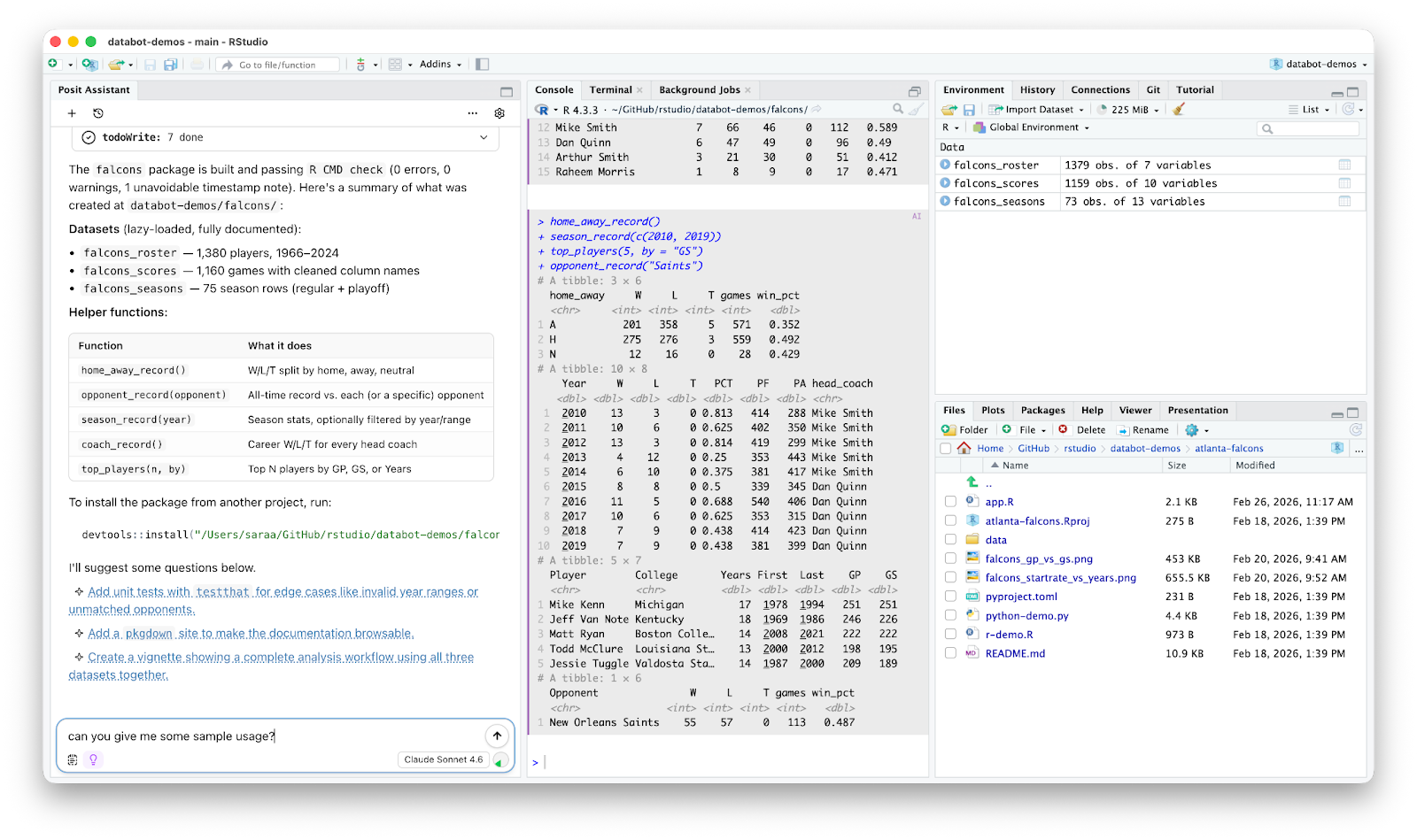
Posit Assistant (March 2026)
A few things that Posit Assistant does differently from some of our earlier tools:
- It’s general-purpose. Although it’s an evolution of Databot and has the same EDA capabilities, it can also function as a general-purpose coding agent.
- Posit Assistant has access to your R session, meaning it can see console output, capture plots/visualizations, and inspect variables in your environment. This is an improvement over a browser-based coding assistant, or even over tools like Claude Code, which require some configuration to see your R session. We think this not only makes the tool more useful, but makes it more likely to give you accurate answers, since it is less likely to hallucinate column names or produce code that throws errors.
- There are many safety and usability features built in, including a more granular permissions system, a set of specialized skills for data science, and the abilities to enable thinking and use a read-only plan mode.
Posit Assistant is available through the $20/mo Posit AI subscription.
From here
Posit Assistant is a multi-platform data science agent. Following the early release in RStudio, we’ve transitioned our focus to refining the experience in other platforms and are excited to share more on this front soon.
We also know that Posit Assistant will not be the final evolution of our data science agents. We’re continually experimenting with other interfaces that take advantage of models’ new capabilities to help data scientists analyze data correctly, transparently, and reproducibly.
We’ll also continue releasing many of these experiments as open-source software. You might check out a set of agent Skills for data science, an agent-focused R REPL, and Docs-style LLM code review. If you’re interested in staying up to date, keep an eye on this newsletter!