AI Newsletter 2026-01-16



Welcome back! If 2026 is anything like 2025, it will be another big year for AI development. We're excited to keep bringing you news from Posit and the broader AI ecosystem every other week.
External news
Claude Code + Opus 4.5
Claude Code and Opus 4.5 had a bit of a moment in the last few weeks of 2025, with many people finally sitting down to try the tools and being surprised at what they can actually do.
Claude Code is probably the most effective coding agent available today. This effectiveness comes both from the strength of the underlying LLMs and from the harness design. If you haven’t already tried Claude Code with Opus 4.5, we’d recommend doing so (no matter what kind of coding projects you’re working on) to get a clearer sense of the current frontier.
Opus 4.5, in particular, feels like it has a stronger “cognitive core” than other frontier models and is less prone to obvious mistakes or nonsensical behavior than its peers from other labs.
Organizational values and AI
Internally, we've also been having conversations about what advances in LLMs mean for software development, writing, and collaboration. In particular, this blog post from Bryan Cantrill at Oxide sparked a lot of discussion. Cantrill argues that integrating LLMs into your workflows should not change your core values, and that your organization’s use of LLMs should support those values.
As the post describes, Oxide uses their organization’s values (which include responsibility, rigor, and teamwork) to determine how to use LLMs for software development and other work. At Posit, we have always focused on making tools that produce correct, transparent, and reproducible analyses, and we carry those values to the development of our AI tools as well.
Posit news
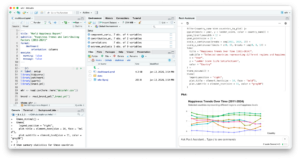
- AI is coming to RStudio! If you’re an RStudio user interested in trying out a new agent, sign up for our beta testing waitlist. Here’s a preview screenshot:
- A new release of Posit Package Manager includes an MCP server that provides information on available packages.
- Davis Vaughan wrote about using Claude Code to address breaking changes from a recent dplyr update. He was able to semi-automate 200 pull requests, saving a lot of manual effort along the way.
Terms
A harness or scaffold is the set of prompts, tools, and other infrastructure that allows an LLM to behave as an agent that can interact with its environment. Coding agents like Databot, Claude Code, and Codex are constructed from a model (Sonnet 4.5, GPT-5, etc.) and a harness.
LLMs are powerful on their own, but the specifics of the harness can make or break the usefulness of an agent. For example, Opus 4.5 nearly doubled its accuracy on the CORE-Bench benchmark when used with Claude Code, compared to the benchmark authors’ own harness (CORE-Agent).
A good harness doesn’t just give an agent access to files or tools. It can also shape the model’s behavior to improve performance, prompting it to work incrementally, track progress, test its work, etc. And if the same team develops both a model and a harness (e.g., Anthropic with Claude Code), they can fine-tune the model to work well with the harness, and develop the harness to work well with the model.
Learn more
- OpenAI rolled back its model router system for its free and cheapest tier (ChatGPT Go) users. The router system dynamically sends requests to different models depending on the complexity of the user’s prompt. Now, ChatGPT will default to GPT-5.2 for free and Go plan users.
- Steve Yegge's Gas Town is a multi-agent orchestration system, whose philosophy leans towards prioritizing speed and quantity of code generation. This post provides an interesting counter approach, instead prioritizing code verification.

Sara Altman

Simon Couch
Related Content

How to secure your organization's agent plugins in Posit Package Manag...

How Posit Team governs AI for enterprise data science and research
