2026-02-13 AI Newsletter



External news
Last week, Anthropic and OpenAI released Claude Opus 4.6 and GPT-5.3-Codex, respectively. GPT-5.3-Codex is currently only available in Codex, OpenAI’s coding agent.
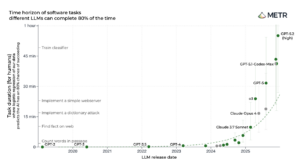
Both new models represent incremental improvements over their predecessors. However, it does feel worth reiterating what we’ve said previously: coding agents used to feel merely like interesting experiments, but agents like Claude Code and Codex, powered by the labs’ recent models, are now solid, consistently useful products with widespread adoption. Internally, many of our engineers have experienced a step change in performance in recent months, a feeling corroborated by METR’s task time horizon analysis (see the Terms section below for more details).
Posit news
AI in RStudio
As we announced last week, Posit Assistant, our data science agent for RStudio, is now in beta testing. We're really excited about it, and we'll have more news in the coming weeks! You can still sign up for the beta testing waitlist here. Here’s a quick peek at how it works:
Call for posit::conf talks
The call for talks deadline for posit::conf(2026) has been extended to Friday, February 20. Learn more: https://posit.co/blog/posit-conf-2026-call-for-talks/
Terms
In March 2025, the AI research nonprofit METR introduced a metric called the task-completion time horizon to track the capability of AI agents. METR tests models on a suite of software engineering tasks, and also measures how long each task takes a human expert to complete (the task duration). The time horizon is the task duration at which a model is estimated to succeed at a certain level of reliability (e.g., 80%). For example, the point in the furthest upper right corner of the plot shows that GPT-5.2 can complete tasks that take human experts an hour with an 80% rate of success. The most capable models' time horizons have roughly doubled every seven months.
METR’s time horizon plot has become a frequently cited artifact, used by a variety of parties to make sweeping predictions about the future of AI. However, you should be careful with how you interpret the plot. As lead author Thomas Kwa clarifies, “Time horizon is not the length of time AIs can work independently.” The tasks are also primarily coding tasks, and so are not representative of all tasks humans do.
Learn more
- Epoch AI looked into the profitability of AI companies. This post is an interesting deep dive into the costs involved in developing and running AI models.
- OpenAI wrote about their in-house data agent, which lets teams within OpenAI get answers to internal data questions.
- With James Wade's shinymcp package, you can convert Shiny apps into MCP apps that run directly inside AI chat interfaces like Claude Desktop.
- Wes McKinney announced msgvault, a tool that archives and indexes your email, allowing you to search and query it with LLMs.

Sara Altman

Simon Couch
Related Content

The Test Set 1 Year

Posit wins two Snowflake Partner Awards and launches Posit Assistant a...
