Make your AI Agents smarter with Posit Package Manager


As agentic coding has begun to permeate all aspects of computing, especially data science, so too have we seen its limitations. AI agents, while helpful in suggesting useful packages for certain tasks, are often drawing from a broad public view of what’s available, without the important context that represents your own environment and governance decisions.
Enter Package Manager’s Model Context Protocol (MCP) server – a new tool to help LLMs leverage your own source-of-package-truth to provide more timely, relevant suggestions and coding assistance based on the packages best suited (and approved) for you.
The Core Value: Structured Package Intelligence for Research and Data Science
The Posit Package Manager MCP server acts as the authoritative backend service, exposing package information, capabilities, and metadata to AI assistants, such as Positron Assistant and Databot, or other agents such as Claude Code, GitHub Copilot, or any that communicate using the MCP standard. Instead of LLMs relying solely on outdated or generalized training data, they can instantly retrieve current, detailed metadata about both public and internal R packages directly from your secure repositories in Package Manager.
This capability ensures safer, more compliant data science because AI agents and users can know exactly what packages and dependencies are allowed and how they work within the organization’s established policies.
Value for Data Scientists: Speed and Flexibility
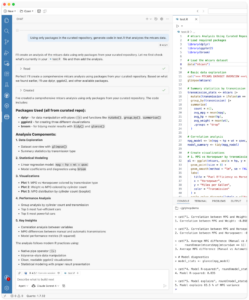
For data scientists, the MCP server enables more reliable and trustworthy analyses by enabling your AI agents, such as Positron Assistant and Databot, to provide you with up-to-date information about approved packages, without wasting your time by providing recommendations that don’t apply to you.
The MCP server allows data scientists to leapfrog manual search and validation steps:
|
New MCP Feature |
Enabled Research/Data Science Capability |
Value for Data Scientists |
|
Intelligent Package Discovery |
LLMs can query for context-specific recommendations, such as "What are the top 10 most popular R packages for data manipulation?". |
Accelerates the discovery phase of code-first statistical analysis, ensuring researchers select approved packages. |
|
Instant Package Details |
For both public and internally developed packages, easily retrieve key package information, metadata, version history, and documentation highlights. |
Streamlines project development by providing immediate technical reference needed for analysis or sharing results. |
|
Binary Availability Checks |
Quickly check if platform-specific binaries (e.g., Windows binaries for Rcpp) are available, along with installation instructions. |
Enables users to avoid compilation delays on their local machines, dramatically speeding up the setup of reproducible analysis environments. |
|
Vulnerability Checks |
Identify if your current project uses any packages with known vulnerabilities. |
Enables users to ensure safe research and data science projects before issues arise. |
The value doesn’t end there. IT teams have more confidence that AI agents in properly configured Posit Team deployments are operating within governance policies. For example, if an organization restricts or blocks the use of a certain package, AI agents that use the MCP server can avoid recommending that package for users.
The MCP server for Posit Package Manager is available to our Enhanced and Advanced tier customers as of our 2025.12.0 release.
By channeling accurate, secure, and up-to-date package intelligence through the MCP server, Posit Package Manager empowers data scientists with accelerated time-to-insight and more reliable analyses. IT leaders are better able to ensure governed data science, helping your organization confidently build and scale trusted, compliant AI workflows efficiently.
Read more in the Package Manager release notes and documentation.

Posit Team
Related Content

How to secure your organization's agent plugins in Posit Package Manag...

How Posit Team governs AI for enterprise data science and research
