Posit Workbench for Financial Services and Insurance


Data science teams rely on powerful, flexible tools that support the entire analytical lifecycle, from initial exploration to final production. Integrated Development Environments (IDEs) are central to this work, providing intelligent code completion, debugging, and version control integration that significantly boosts productivity, all while mitigating regulatory pressure.
Financial institutions face unique challenges driven by high data volume, fragmented development environments, the necessity for speed, and intense regulatory scrutiny. Without a centralized development platform, data science teams encounter hurdles like dependency management, access consistency, and operational risk. Overcoming these obstacles requires specialized tools that bridge the gap between individual development and team-wide collaboration.
Posit Workbench, part of the Posit Team platform, provides significant value to financial service organizations by delivering a centralized, auditable, and flexible development environment. It achieves this by providing three key areas of support:
1. Flexible IDEs and Centralized Project Management
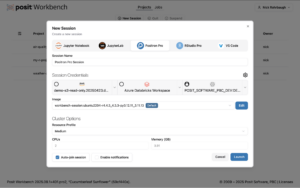
Modern data scientists have diverse preferences and needs, often requiring different editors for different tasks. Posit Workbench supports this reality by offering multiple IDE choices, allowing users to launch and work within various popular environments directly from the browser.
- IDE Choices: Users can choose from Positron, RStudio, VS Code, JupyterLab, and Jupyter Notebooks..
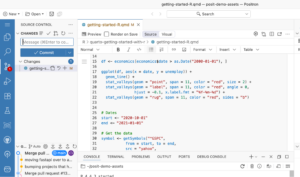
- Positron: The introduction of Positron—Posit's next-generation IDE built on the Code OSS foundation—further enhances this ecosystem, providing a modern experience directly within Workbench that is designed for multi-language (R and Python) data science workflows and while offering an enterprise-ready experience.
- Centralized Access: Workbench simplifies project setup, sharing, and access control, providing a single point of entry for all projects. This streamlines onboarding for new team members and simplifies project handovers.
- Scalability and Resource Management: Workbench helps analysts access the necessary computational resources they need to analyze large financial datasets and scale to handle complex quantitative projects
2. Consistent, Reproducible Results
Reproducibility is a non-negotiable requirement in data science, ensuring that the same results can be consistently generated by anyone, at any time. When this fails, confidence in data-driven decisions collapses.
- Environment Consistency: Workbench solves the frustrating “it works on my machine” problem by integrating seamlessly with environment managers like uv, venv, and renv and supporting custom images. This ensures that every project runs with the right dependencies, eliminating environmental inconsistencies that prevent reproducibility.
- Version Control: With native Git integration, Posit Workbench enables reliable code versioning, collaborative development, and clear audit trails for all analytical scripts. This also strengthens traceability and code lineage, which are critical for model risk and governance teams who need a transparent record of how analyses and models evolve over time.
3. Resource Management and Security
For enterprise and scaled data science, the platform must meet the needs of IT and governance teams.
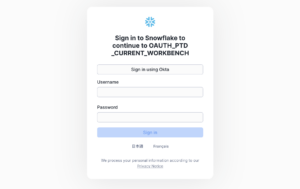
- Security and Control: Workbench offers essential features for managing computational resources, user authentication, and authorization to data and other cloud services. This ensures that sensitive data and models are protected and compliant with organizational standards.
- Efficiency: By providing a unified and managed environment, Posit Workbench empowers data science teams to focus on their core work—building models and extracting insights—rather than dealing with infrastructure complexities or technical incompatibilities.
- Auditable Development Environment: Workbench provides a centralized, auditable Python and R development environment that integrates with modern security and data governance standards. This standardization helps mitigate operational risk related to using open-source packages and tools.
By leveraging platforms like Posit Workbench, organizations can overcome the common pitfalls of inconsistent environments and foster a truly collaborative ecosystem where teams work efficiently and effectively while supporting model governance, auditability, and consistent development practices at scale.

Posit Team
Related Content

Tiny Doses for Tiny Babies -- How much is too much?

2026 Posit Impact Awards
