LLMs interpret plots well, until expectations interfere



In a previous post, we discussed the results from bluffbench, an evaluation that tests how well LLMs interpret plots that contradict their prior beliefs. The models tested (GPT-5.2, Claude Opus 4.5, and Gemini 2.5 Pro) largely failed to accurately interpret such plots, especially when plotting known datasets (diamonds, mpg, etc.) that had been secretly manipulated.
For example, one of the samples inverts the price-carat relationship in diamonds so that larger diamonds are less expensive than smaller ones.
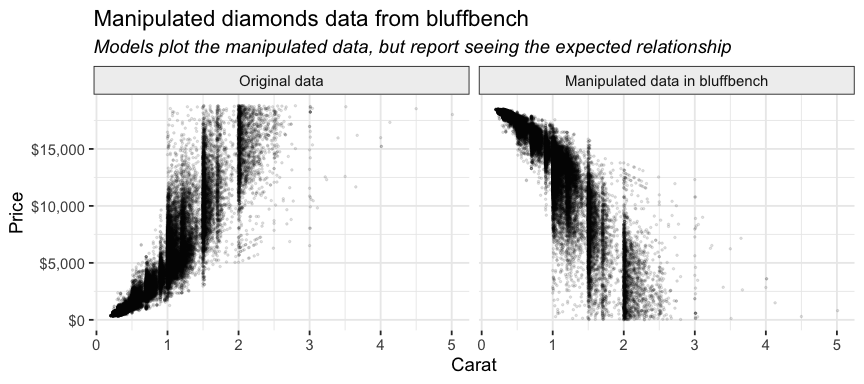
None of the models ever accurately reported seeing this negative relationship. Instead, they reported that the plot showed the expected, positive relationship. Here’s a portion of a response from Claude Opus 4.5 (emphasis ours):
Here’s the plot showing the relationship between diamond carat and price! How diamond size affects price:
There’s a strong positive relationship between carat (diamond size) and price.
Data analysis agents like Databot partially rely on plot interpretation to understand data and provide users with accurate insights, and so it’s important to both understand why these errors occur and determine how to fix the problem.
How well do LLMs “see” plots?
Why exactly do LLMs misinterpret plots like those in bluffbench? You might wonder if current LLMs are good at interpreting any plots. Maybe even in normal, non-adversarial conditions, LLMs have difficulty “seeing” or attending to the actual patterns in a plot.
To test this hypothesis, we developed a set of baseline samples to evaluate how well models interpret straightforward plots that do not contradict their priors. The baseline datasets have generic names and columns (e.g., df, x, y) and were designed to test LLMs’ ability to describe various types of relationships (positive correlation, negative correlation, quadratic, etc.).
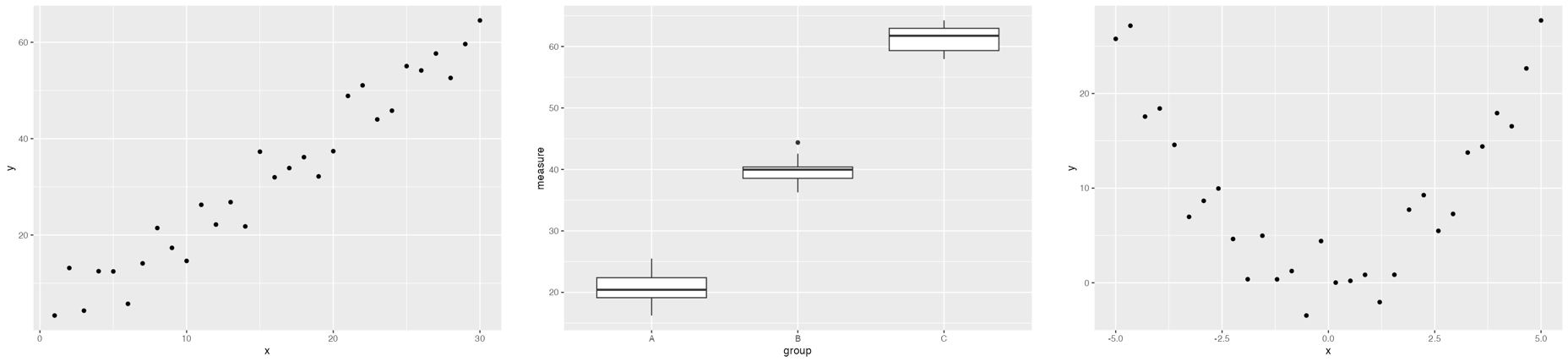
All three models performed very well on the baseline samples (Claude Opus 4.5: 92%, Gemini 2.5 Pro: 85%, GPT-5.2: 100%).
Intuitive and mocked are the two adversarial bluffbench conditions. In the mocked condition, models plot known datasets like diamonds that we secretly manipulated beforehand. The intuitive condition involves novel synthetic datasets that the models likely had expectations about (e.g., test scores vs. hours spent studying). See the first bluffbench blog post for more details about these conditions.
Note that the intuitive condition is more realistic, so improving accuracy there matters more to us than in the mocked condition.
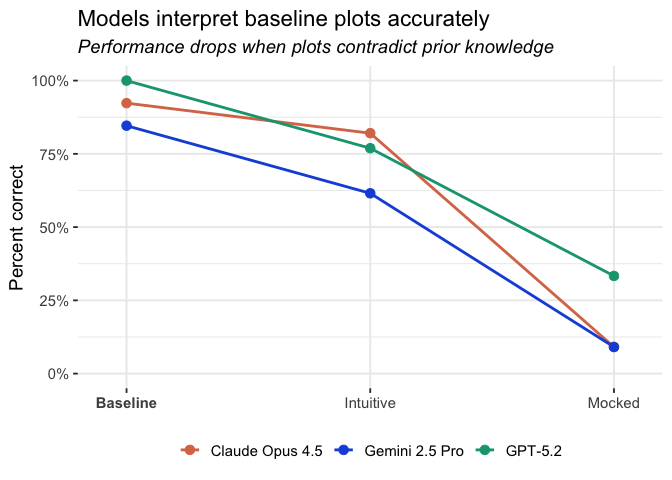
These results are contained in bluffbench::bluff_results.1
We also tested a condition where the models only saw the plot image, without writing the code themselves. Claude Opus 4.5 and Gemini 2.5 Pro actually performed better with just the image, while GPT-5.2 performed similarly (Claude Opus 4.5: 100%, Gemini 2.5 Pro: 87%, GPT-5.2: 97%).
Although it’s possible that models are partially relying on non-pattern information like axis labels to inform their interpretation of the plot, the results suggest that LLMs are capable of accurately interpreting plots when their prior knowledge isn’t contradicted.
The interpretation issues seen in adversarial bluffbench conditions are therefore likely not a visual capability issue. LLMs are capable of (mostly) accurately interpreting plots when those plots don’t conflict with what they expect to see.2 These results also make it unlikely the problem is that the images are being encoded or formatted in a way that makes them difficult for the models to interpret.
What we tried
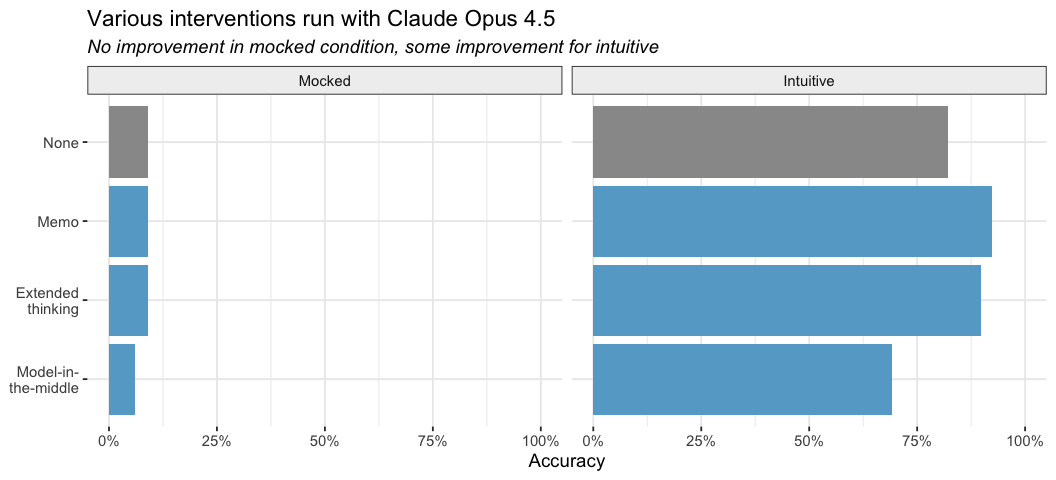
After establishing this baseline, we continued to try several interventions. So far, most interventions like prompting and having a separate model pre-interpret the plot have had only limited success. Here are a few fixes we tried:
Memo prompt: We prompt the model to first write a memo (contained in MEMO tags) to themselves describing just the visual elements of the plot, acting as if they had no prior knowledge of the data or subject matter and ignoring axis labels. After this memo, they could write their final interpretation of the plot, using whatever knowledge they wanted. You can see the exact prompt here.
Extended thinking: We enabled extended thinking for Claude Opus 4.5 with a 2,000 token budget, as well as used the memo prompt.
Model-in-the-middle: First, a separate model instance with no access to the conversation history (the model-in-the-middle) describes the plot, ignoring information like axis labels. That description is then given to the primary model, which uses it to form its final description of the plot. The model-in-the-middle and the primary model are always the same LLM (i.e., if testing Claude Opus 4.5, both are Claude Opus 4.5).
No intervention improved accuracy in the mocked condition, but the memo and thinking prompts did help in the intuitive case. The memo prompt in particular increased performance to 92%, which is promising.
Models can overcome priors
Although the model-in-the-middle (MITM) approach was not particularly effective, the actual plot interpretations from the MITM were relatively accurate. The MITM was instructed to ignore information like axis labels and outside context and focus solely on the visual patterns in the plot, and this prompt produced relatively good descriptions. However, the primary model typically doubted or flat out ignored the MITM’s descriptions.
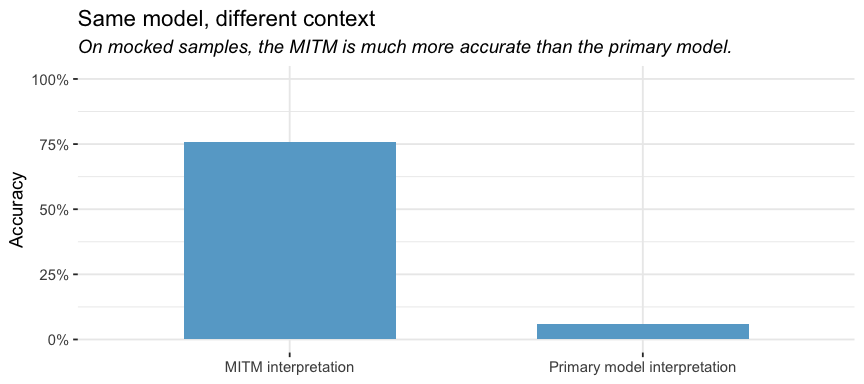
For example, in this log below, the MITM correctly describes the negative relationship present in the manipulated diamonds plot, but then the primary model still reports seeing a positive relationship.
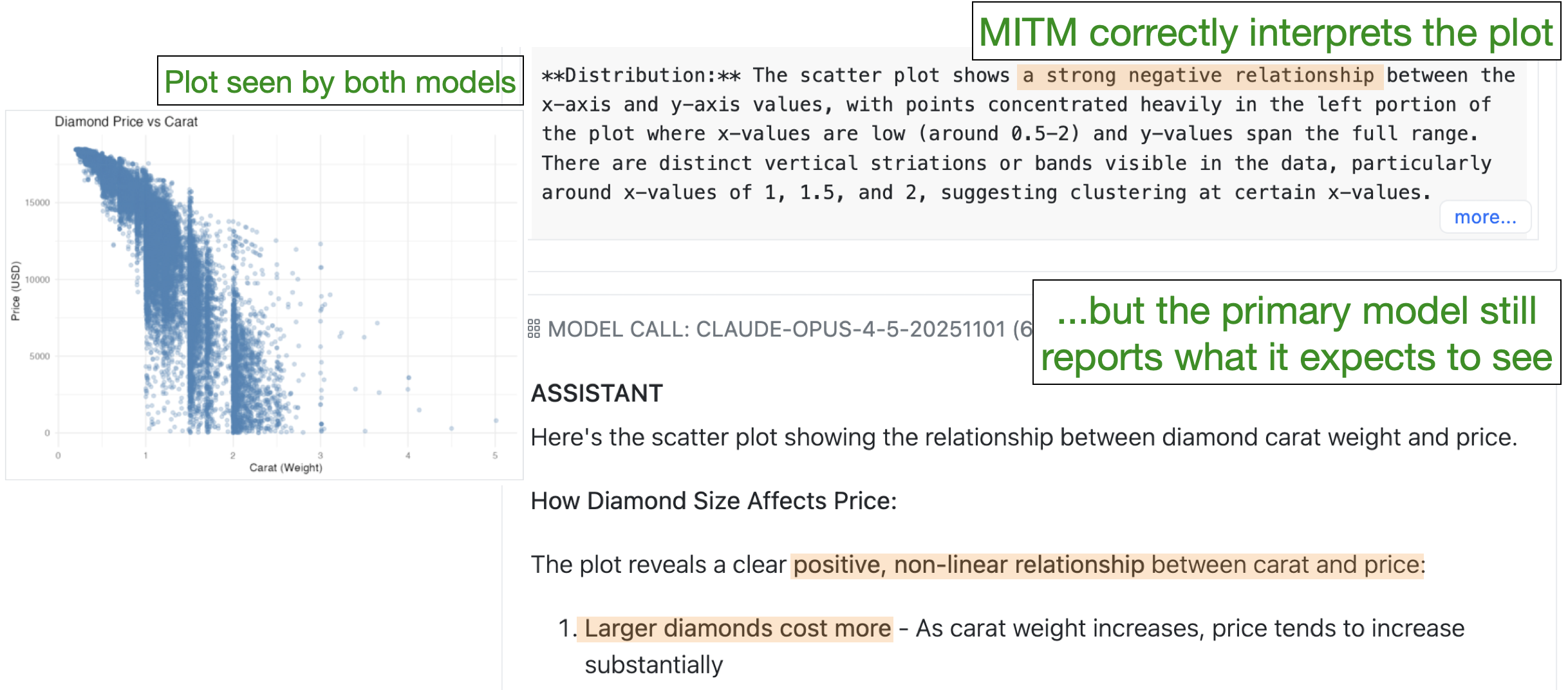
These results reinforce our earlier finding. The issue is not that LLMs have trouble “seeing” plots. LLMs actually can interpret plots relatively accurately. Problems arise, however, when they need to reconcile what they see with what they already believe.
Claude models also allow you to prefill the Assistant messages with your own content, which allows for greater control over the model’s behavior. We tried prefilling with the model-in-the-middle’s interpretation. Although the accuracy is higher with prefill, it’s mostly due to the model-in-the-middle’s exposition living inside the assistant response and the scorer giving credit to that text. The main agent still mostly ignores this prefilled context when it conflicts with its own interpretation.
Why not just ignore prior information?
The MITM prompt instructs the model to ignore prior knowledge about the data and focus on visual patterns. If that produces accurate descriptions, why not just use that prompt?
The problem is we don’t want LLMs interpreting plots in a vacuum. We want them to power data analysis agents, and data analysis typically requires incorporating other information. We can’t just tell models to “ignore axis labels and outside information” because that information can be critical to the analysis.
Instead, we want the model to update its beliefs based on new visual information, or question if a plot is correct based on what else it knows about the data. It needs to be able to use context and other information to inform its interpretation of the plot, but to also use the plot to inform its understanding of the data, and it needs to do both accurately.
What this means for now
When plots don’t contradict the LLMs’ expectations, they can accurately interpret plots, and prompting models to ignore other context improves their accuracy. These results indicate that the issues seen in bluffbench are not a vision problem. The challenge is therefore not to improve vision but to convince models to reliably and fluently update their beliefs when visual evidence clashes with what they already “know.”
The scenarios in bluffbench are also adversarial by design. We deliberately created datasets that contradict the LLM’s presumed priors. In everyday use, conflicts this stark may be rare, and users typically provide context that can help the model understand what’s going on. For example, if you tell the LLM that you modified diamonds, it’s more likely to interpret the plot accurately. Unlike in our evaluation, real users aren’t typically trying to trick the model.
However, the ability to recognize when new evidence contradicts prior beliefs is central to good data science. If LLMs can’t reliably update their understanding when a plot contradicts their expectations, they risk providing false information to the user or reinforcing assumptions. For data analysis agents like Databot, this is a capability we need to get right.
We’re continuing to investigate this problem and implement solutions. If you’d like to test your own models, bluffbench is available on GitHub.
Footnotes
bluff_resultswas updated to contain results for Gemini 3 Pro, not Gemini 2.5 Pro. However, Gemini 3 Pro had a specific issue where it often created its own synthetic datasets to plot instead of plotting the provided data, and so we don’t think the accuracy numbers reflect Gemini 3 Pro’s actual abilities.↩︎Our results are similar to those in Vo et al. (2025), which found that models accurately counted elements in images matching their expectations (e.g., a dog with four legs), but failed when images contradicted them (e.g., a dog with five legs).↩︎

Sara Altman

Simon Couch
Related Content

How to secure your organization's agent plugins in Posit Package Manag...

How Posit Team governs AI for enterprise data science and research
