Posit Legal
Benefit Corporation Annual Report
Posit Software, PBC
A Message from our Founder & CEO
Posit aims to create free and open-source software for data science, scientific research, and technical communication in a sustainable way, because it benefits everyone when the essential tools to produce and consume knowledge are available to all, regardless of economic means.
We believe corporations should fulfill a purposeful benefit to the public and be run for the benefit of all stakeholders including employees, customers, and the larger community.
As a Delaware Public Benefit Corporation (PBC) and a Certified B Corporation®, Posit’s open-source mission and commitment to a beneficial public purpose are codified in our charter, requiring our corporate decisions to balance the interests of the community, customers, employees, and shareholders.
B CorpsTM meet the highest verified standards of social and environmental performance, transparency, and accountability. Posit measures its public benefit by utilizing the non-profit B Lab®’s “Impact Assessment”, a rigorous assessment of a company’s impact on its workers, customers, community, and environment.
In 2019, Posit (then RStudio) met the B Corporation certification requirements set by the B Lab. In 2023, our certification was renewed, and we are proud to share that our B Lab Impact Assessment score rose from 86.1 to 92.5 with this renewal. The B Lab certification process uses credible, comprehensive, transparent, and independent standards to measure social and environmental performance. Details of these assessments can be found on our B Lab company page.
To fulfill its beneficial purposes, Posit intends to remain an independent company over the long term. With the support of our customers, employees, and the community, we remain excited to contribute useful solutions to the important problems of knowledge they face.
J.J. Allaire
Founder & Executive Chair, Posit PBC
Tareef Kawaf
President & CEO, Posit PBC
Introduction
Posit’s mission is to create free and open-source software for data science, scientific research, and technical communication. We do this to enhance the production and consumption of knowledge by everyone, regardless of economic means, and to facilitate collaboration and reproducible research, both of which are critical to the integrity and efficacy of work in science, education, government, and industry.
In addition to our open source products, Posit produces a modular platform of commercial software products that enable teams to adopt R, Python, and other open-source data science software at scale. Posit also offers online services that make it easier to learn and use data science tools over the web.
Together, Posit’s open-source software and commercial software form a virtuous cycle. In most companies, a “customer” is someone who pays you. For us, a “customer” must include the open source community, with whom we exchange the currencies of attention, respect, and love. When we deliver value to our open source users, they will likely bring our software into their professional environments, which opens up the possibility of commercial partnerships. To keep this cycle flowing, our open source developers must know and care about the integrations with proprietary solutions that matter to our enterprise customers. It also means that Posit’s commercial teams consistently provide value to individuals who may never directly spend a dollar with us.
Posit’s approach is not typical. Traditionally, scientific and technical computing companies create exclusively proprietary software. While it can provide a robust foundation for investing in product development, proprietary software can also create excessive dependency that is not good for data science practitioners and the community. In contrast, Posit provides core productivity tools, packages, protocols, and file formats as open-source software so customers aren’t overly dependent on a single software vendor. Additionally, while our commercial products enhance the development and use of our open-source software, they are not fundamentally required for those without the need or the ability to pay for them.
As of December 2024, Posit is spending ~35% of its engineering resources on open-source software development, and is leading contributions to over 350 open-source projects. Posit-led projects targeted a broad range of areas including the RStudio IDE; infrastructure libraries for R and Python; numerous packages and tools to streamline data manipulation, exploration and visualization, modeling, and machine learning; and integration with external data sources. Posit also sponsors or contributes to many open-source and community projects led by others, including NumFOCUS, the R Consortium, the Python Software Foundation, DuckDB, Pandoc, pyodide, and ProseMirror, as well as dozens of smaller projects via the Open Source Collective or directly on Github. Additional information about our products and company contributions can be found in our “Year In Review” blog posts.
Today, millions of people download and use Posit open-source products in their daily lives. Additionally, more than 10,000 customers that purchase our professional products help us sustain and grow our mission. It is inspiring to help so many people participate in global economies that increasingly reward data literacy, and know that our tools help produce insights essential to navigating our complex world.
Posit’s Charter and Statement of Public Benefit
Posit’s Charter
We want Posit to serve a meaningful public purpose, and we run the company for the benefit of our customers, employees, and the community at large. That’s why we’re organized as a Public Benefit Corporation (PBC).
What makes a PBC different from other types of corporations?
“A ‘public benefit corporation’ is a for-profit corporation organized under and subject to the requirements of this chapter that is intended to produce a public benefit or public benefits and to operate in a responsible and sustainable manner.” — Delaware Public Benefit Corporations Law
As a PBC and Certified B Corporation, we must meet the highest verified standards of social and environmental performance, transparency, and accountability. Our directors and officers have a fiduciary responsibility to address social, economic, and environmental needs while still overseeing our business goals.
Posit’s Statement of Public Benefit
Creation of free and open source software for data science, scientific research, and technical communication:
- To enhance the production and consumption of knowledge by everyone, regardless of economic means.
- To facilitate collaboration and reproducible research, both of which are critical for ensuring the integrity and efficacy of scientific work.
Our primary obligations as a PBC and Certified B Corporation
Public Benefit Corporation
How we built our company charter
- The board of directors shall manage or direct the business and affairs of the public benefit corporation in a manner that balances the pecuniary interests of the stockholders, the best interests of those materially affected by the corporation’s conduct, and the specific public benefit or public benefits identified in its certificate of incorporation.
- A public benefit corporation shall no less than biennially provide its stockholders with a statement as to the corporation’s promotion of the public benefit or public benefits identified in the certificate of incorporation and of the best interests of those materially affected by the corporation’s conduct.
Certified B Corp
How we hold ourselves accountable to our charter
- Demonstrate high social and environmental performance by achieving a B Lab Impact Assessment score of 80 or above and passing the risk review.
- Make a legal commitment by changing our corporate governance structure to be accountable to all stakeholders, not just shareholders, and achieve benefit corporation status if available in our jurisdiction.
- Exhibit transparency by allowing information about our performance measured against B Lab’s standards to be publicly available on our B Corp profile on B Lab’s website.
Free and Open Source Software and Tools
In 2022 and earlier, when Posit was called RStudio, we were often thought of as an “R company” because of our dedication to developing and maintaining some of the most used R packages in the world. But Posit has always been better described as a scientific software company: supporting Python (via the reticulate package, RStudio language support), working with relational databases and data platforms such as Apache Spark (a cross-platform data frame compatibility via feather/Apache Arrow), and much more mean that we’ve never been solely an “R company”.
More recently, we have built explicitly cross-language tools like Quarto and Positron, along with Python packages like Great Tables, chatlas, and orbital.
Our recent work shares three themes. We are investing in AI, building tools that help data scientists use language models safely. We are rewriting performance-critical components in Rust, so our tools run faster and scale better. And we are supporting production use, with features like multithreading and built-in monitoring.
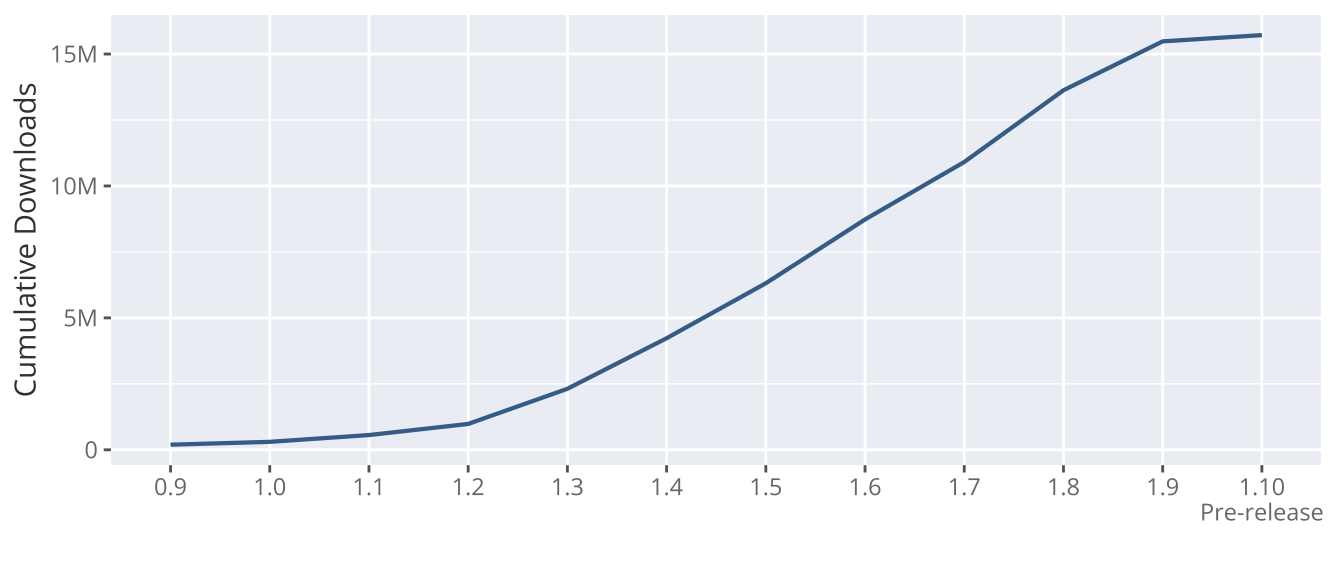
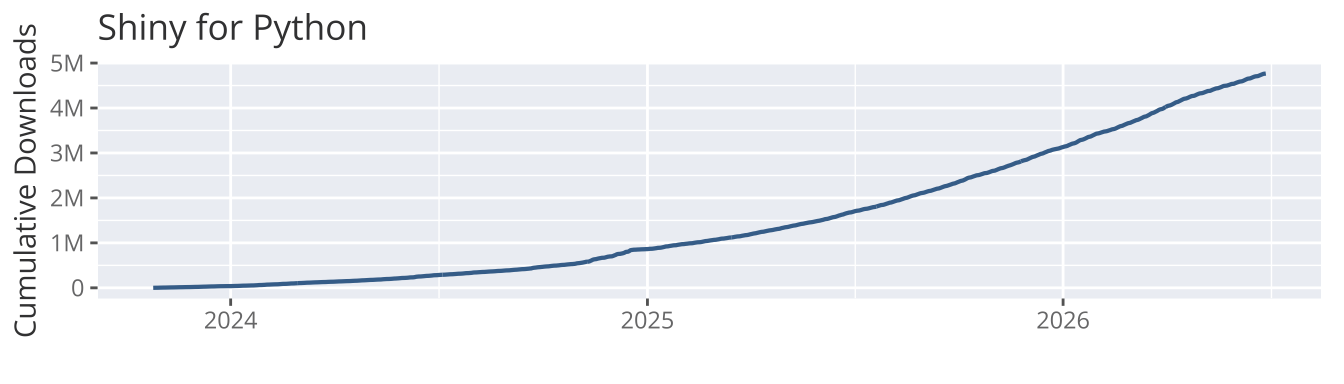
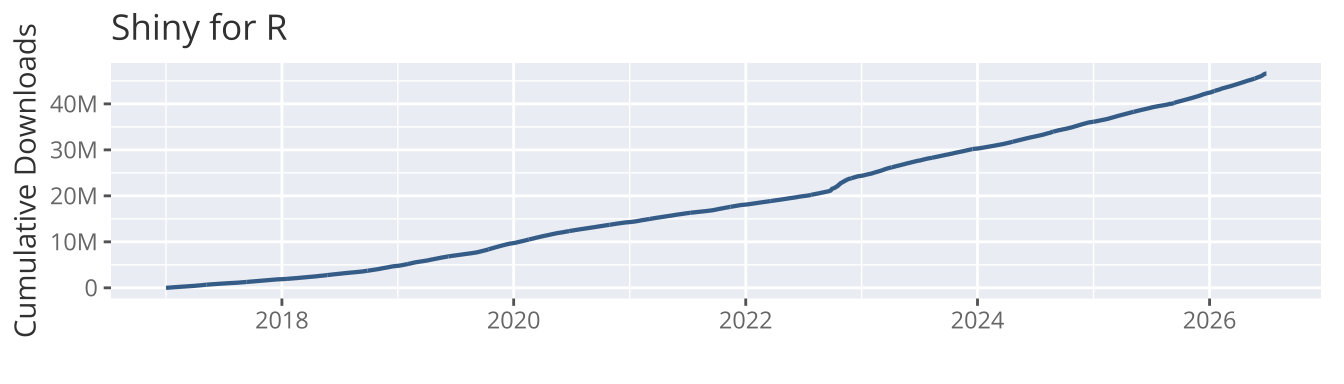
The following subsections highlight selected Posit software projects of interest to the broader data science community. Where metrics are published, please note these represent a lower bound on the actual number, as it is difficult-to-impossible to account for every install and usage in the world. Metrics reflect data as of June 2026.
Quarto
In July 2022, Posit announced Quarto, an open-source publishing system for scientific and technical documents, and the successor to R Markdown. Quarto draws on more than ten years of R Markdown development, but it is a new, language-agnostic project rather than an R library. R Markdown users will find it familiar, and most of their existing documents render unmodified.
Quarto allows users to choose from multiple computational engines (Knitr, Jupyter, and Observable), which makes it easy to use Quarto with R, Python, Julia, JavaScript and many other languages. It also allows users to author documents as plain text markdown or Jupyter Notebooks, and publish to numerous outputs such as HTML, PDF, MS Word, ePub and more, and for the community to develop its own extensions.
Quarto is being rewritten, with critical components moved to Rust. The next major version, Quarto 2, is developed openly at quarto-dev/q2. These Rust components improve performance and report syntax errors more clearly, preserving source locations so problems are easier to fix. The team is also exploring real-time collaboration, enabling authors to write documents together. Posit expects to make a version publicly available later this year.
There are 5 full time equivalent (FTE) employees developing open-source Quarto products as of May 2026.
Shiny
Shiny has been a mainstay in the R community since its launch in 2012, providing a web application framework that makes it easy to tell data stories in interactive, point-and-click apps. In April 2023, Posit released a Python version of Shiny with the same reactive programming model, and the newer Shiny Express syntax makes it easier for Python developers to get started.
New packages (see AI and LLM Enablement) also highlight Shiny as a strong platform for building LLM-powered apps.
Shiny applications can be shared with others via the open-source Shiny Server, Posit Connect Cloud, or Posit Connect. Shiny and related packages include shiny (Python, R), bslib, shinytest, shinyloadtest, shinydashboard, leaflet, crosstalk, brand.yml, shinychat, and querychat.
Shiny also continues to mature for production use. Recent releases added OpenTelemetry support, so teams can monitor live apps and trace their performance. The async framework mirai and the shared-memory package mori keep improving as well, helping Shiny scale to more concurrent users with less memory overhead.
There are 5 FTE Posit employees developing the open-source Shiny and Shiny Server products as of May 2026.
AI and LLM Enablement
Large language models (LLMs) are changing how data scientists work. Posit’s Open Source teams are building tools to help data scientists responsibly use LLMs in their analysis, apply them during development, and incorporate LLM capabilities in the solutions they provide others.
Packages to enable LLMs in data science
- ellmer makes it easy to use large language models (LLMs) from R. It supports a variety of LLM providers and implements a rich set of features including streaming outputs, tool/function calling and structured data extraction.
- chatlas is a flexible Python interface to many LLM providers (playing a similar role to ellmer). It supports tool use, function calling, and streaming responses.
- ragnar (R) and raghilda (Python) bring Retrieval-Augmented Generation (RAG) to data science. They help users index their own data so an LLM can answer with grounded results.
- querychat adds an SQL-powered LLM to Shiny apps. It lets users explore data with natural language. It works in both R and Python.
- mall enables LLM powered sentiment analysis, text summarization, text classification, information extraction and text translation. It is available for both R and Python.
- vitals evaluates LLM products built with ellmer, measuring their accuracy, cost, and speed. In one evaluation, it found that AI agents often ignore information shown in plots when it contradicts expectations.
Selection of packages that assist during development
- gander is a coding assistant that understands R environments and shares context like column names and types to improve help quality.
- chores connects ellmer to your source editor in RStudio and Positron. It automates repetitive programming tasks.
- btw describes your R session to an LLM, including your data, packages, and documentation, so it can give more relevant help.
- mcptools implements the Model Context Protocol in R, letting AI tools such as Claude run code in your R session.
LLMs are also built into RStudio and Positron through Posit Assistant, a coding assistant for data science. Behind it is Posit AI, a shared service and harness developed over the past year by the AI team. Language models are non-deterministic and can hallucinate, so much of Posit’s work goes into making them safe to rely on, through careful evaluation, verification, and keeping data scientists in the loop.
As of May 2026, 7 FTE Posit employees work directly on AI and LLM tools, with further AI development spread across many individual open source product teams.
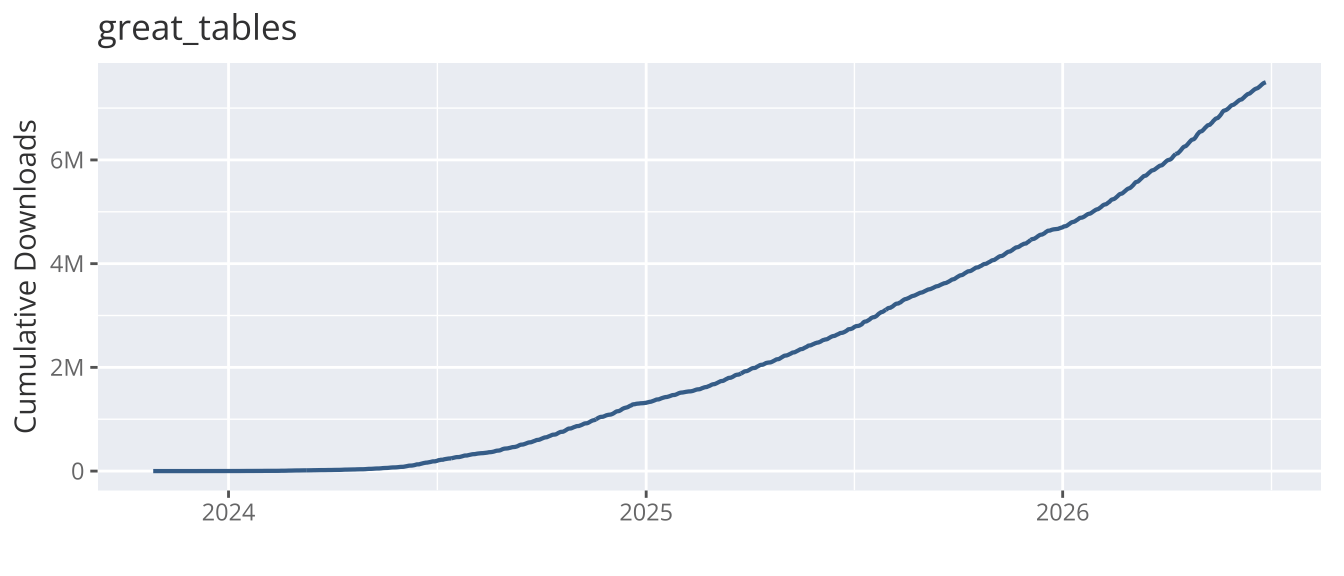
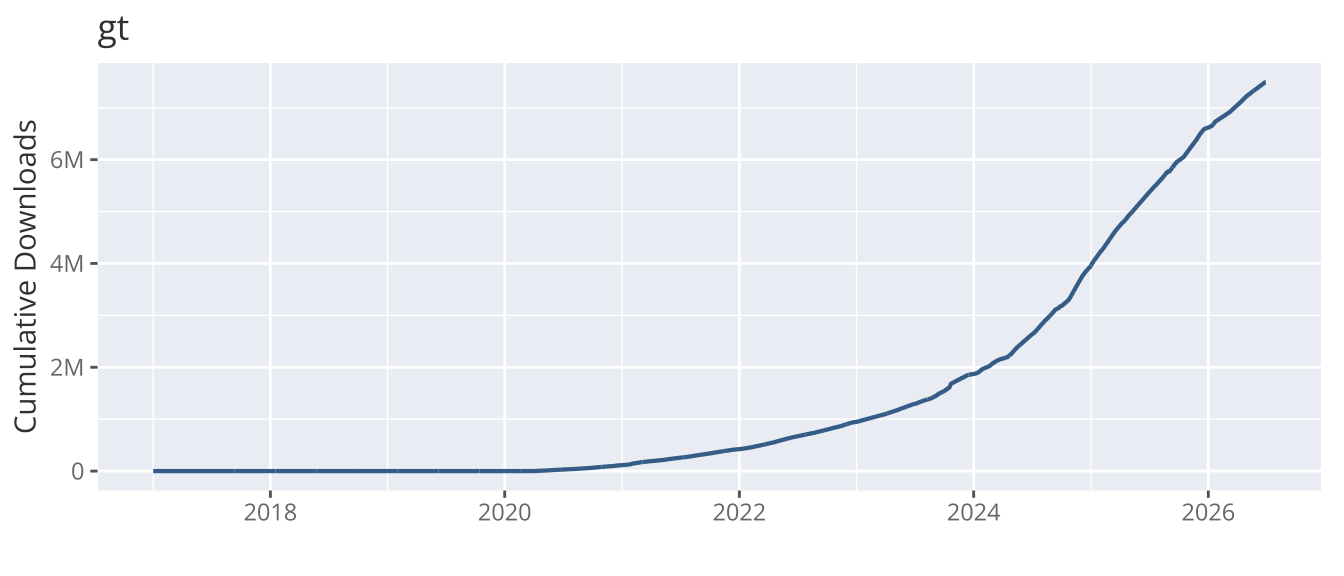
gt / Great Tables
When presenting an analysis, a table can often convey the results more concisely than the most beautiful and interactive of charts. However, the experience of creating and displaying tables in R and Python has been mixed, especially when you want to display something beyond a plain data frame representation.
To that end, the gt and Great Tables packages have defined a “grammar of tables” to solve this problem (in R and Python, respectively), analogous to the “grammar of graphics” for specifying charts.
As of May 2026, there is 1 FTE Posit employee developing gt / Great Tables open-source packages.
Great Docs
Great Docs, introduced in April 2026, builds documentation sites for Python packages. It finds a package’s public API and generates a full site with Quarto, using opinionated defaults that need no configuration to start. Great Docs grew out of quartodoc, Posit’s earlier API reference tool.
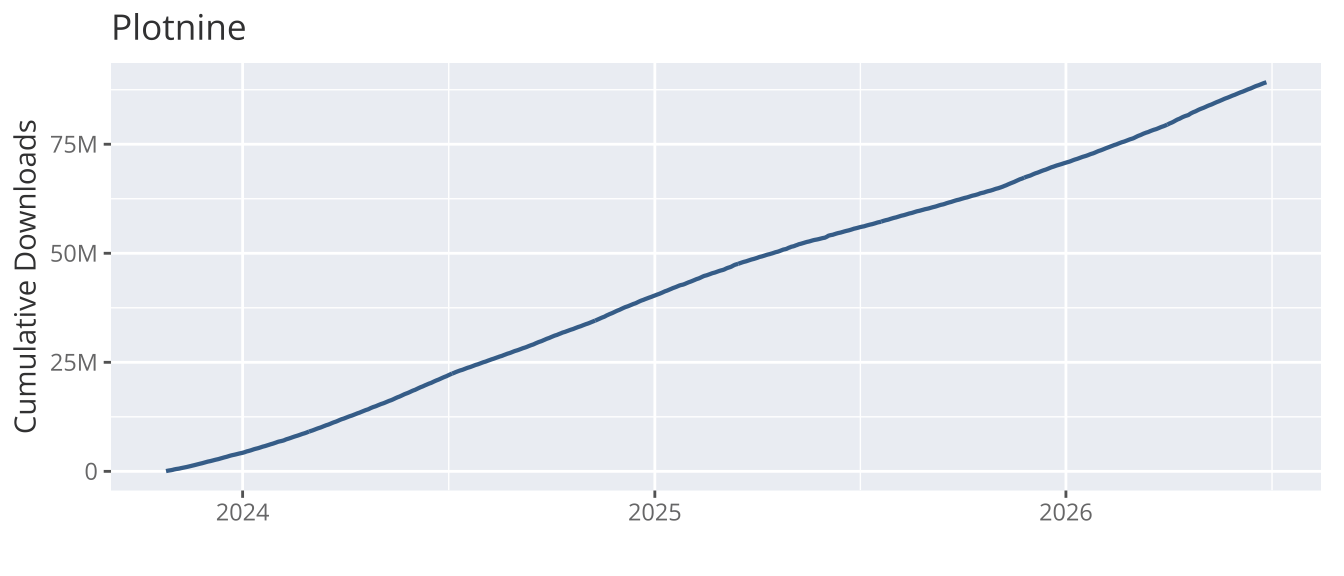
Plotnine
Plotnine is an implementation of the grammar of graphics in Python, heavily influenced by ggplot2 in R. Built on the matplotlib plotting library, custom (and otherwise complex) plots are easy to reason about and build incrementally, while the simple plots remain simple to create.
Tidyverse
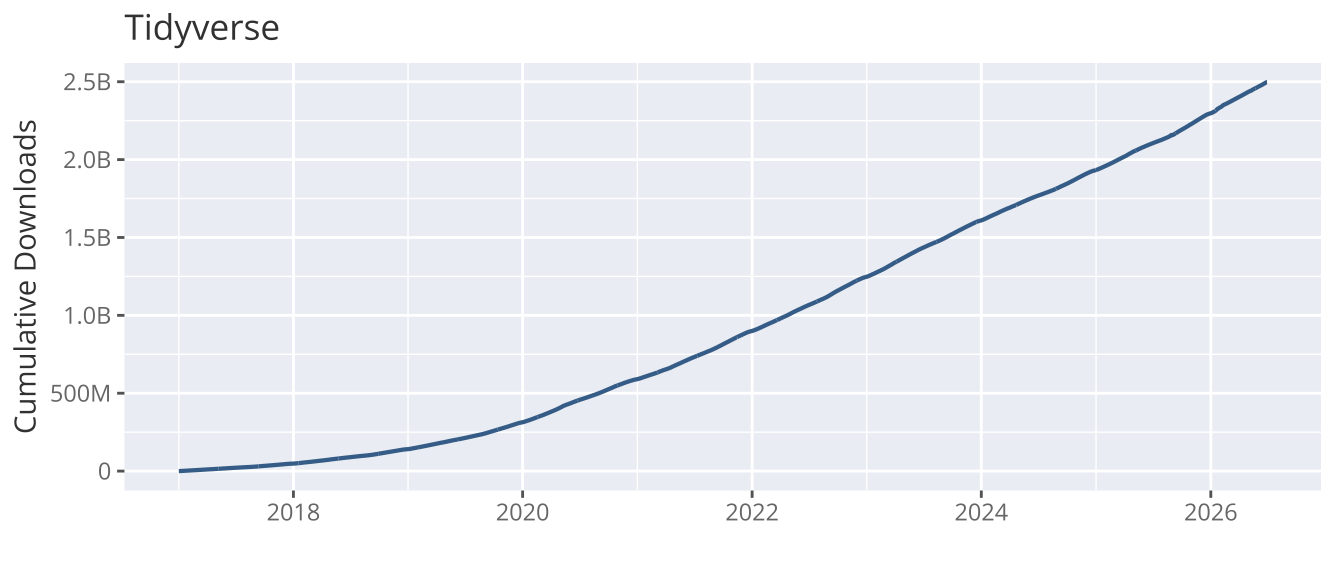
The tidyverse is an opinionated collection of R packages designed for data science. All packages share an underlying design philosophy, grammar and data structures.
The tidyverse consists of nine core packages (including ggplot2, tidyr and readr) and 31 packages overall.
Recent work includes a major ggplot2 overhaul in version 4.0.0, which moved the package to the S7 object system and added new theming controls. purrr also gained parallel processing, built on mirai.
There are 6 FTE Posit employees developing Tidyverse and related open-source products as of May 2026.
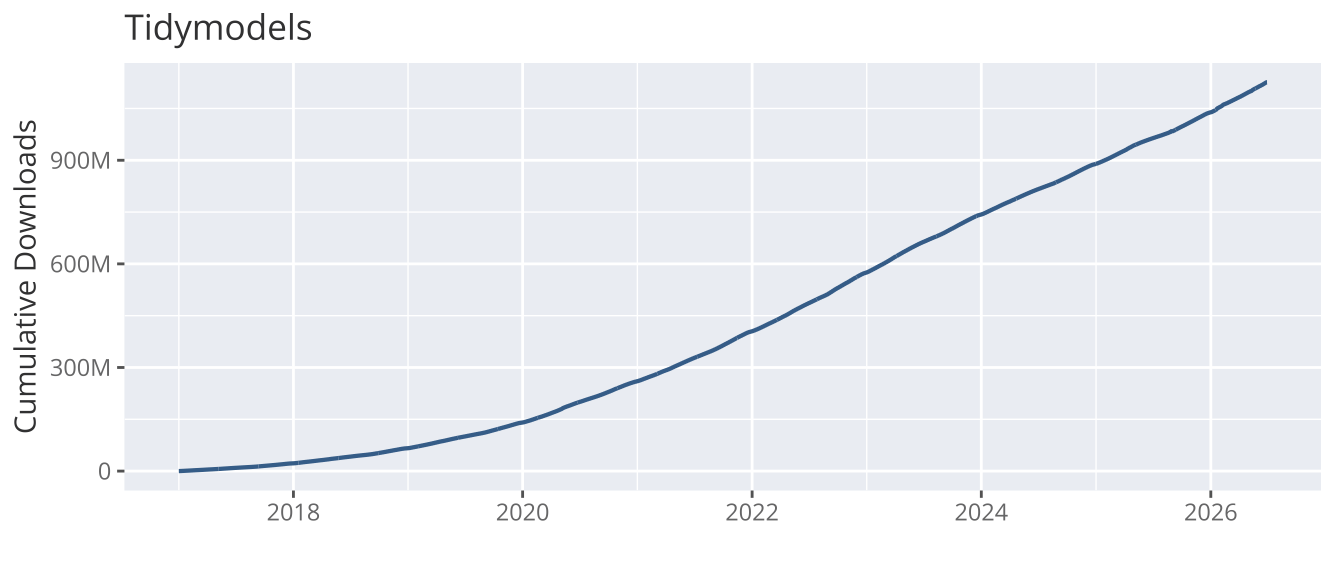
Tidymodels
tidymodels is a collection of packages that perform tasks relevant to statistical modeling and machine learning. Tidymodels packages share a common syntax and design philosophy, and are designed to work well with Tidyverse packages.
There are currently 42 tidymodels packages on CRAN. Popular tidymodels packages include parsnip, rsample, recipes, tune and yardstick.
Recent work includes a parallel-processing overhaul in tune 2.0.0 and new support for sparse data across modeling workflows.
There are 4 FTE Posit employees developing Tidymodels and related open-source products as of May 2026.
SQL Enablement
Posit’s open source ecosystem has long supported R and Python, along with some support for Julia. SQL now joins that list. SQL is one of the most common languages for working with data, so supporting it well matters to a large community of data scientists.
The ggsql project brings the grammar of graphics to SQL. People can build plots directly in their queries, without needing R or Python. ggsql runs in Quarto, Jupyter, Positron, and other tools.
Orbital lets you run machine learning models inside your database. Originally an R package, it now also supports Python. In Python, orbital converts scikit-learn models into SQL, so they can run directly in a database like Snowflake, with no Python environment needed.
The performance gains this approach has provided is quite significant.
Support for SQL is also growing across Posit’s other tools. Both Positron and Quarto are improving how they work with SQL.
Together, these efforts will help bring SQL alongside R and Python in the Posit open source ecosystem.
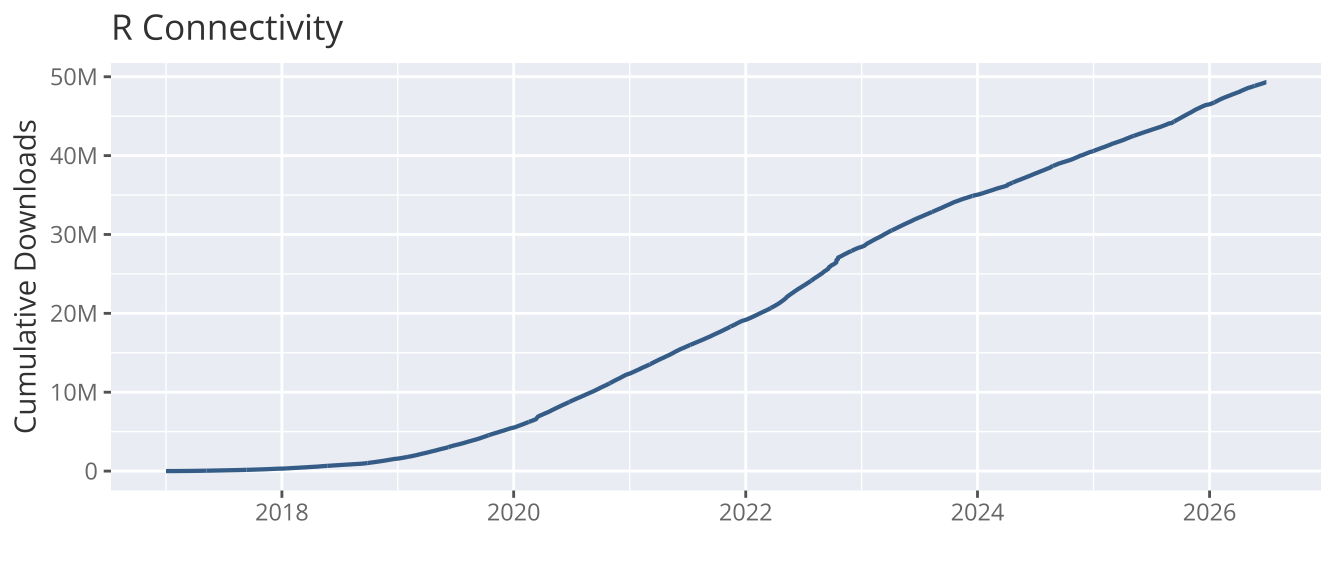
Connectivity Packages
Posit makes open-source packages that connect data scientists to spreadsheets, databases, distributed storage frameworks for big data, machine learning platforms, and the programming environments of other languages, such as Python.
Connectivity packages include: sparklyr, tensorflow for R, keras, odbc, and reticulate.
There are 2 FTE Posit employees creating connectivity-related open-source packages as of May 2026.
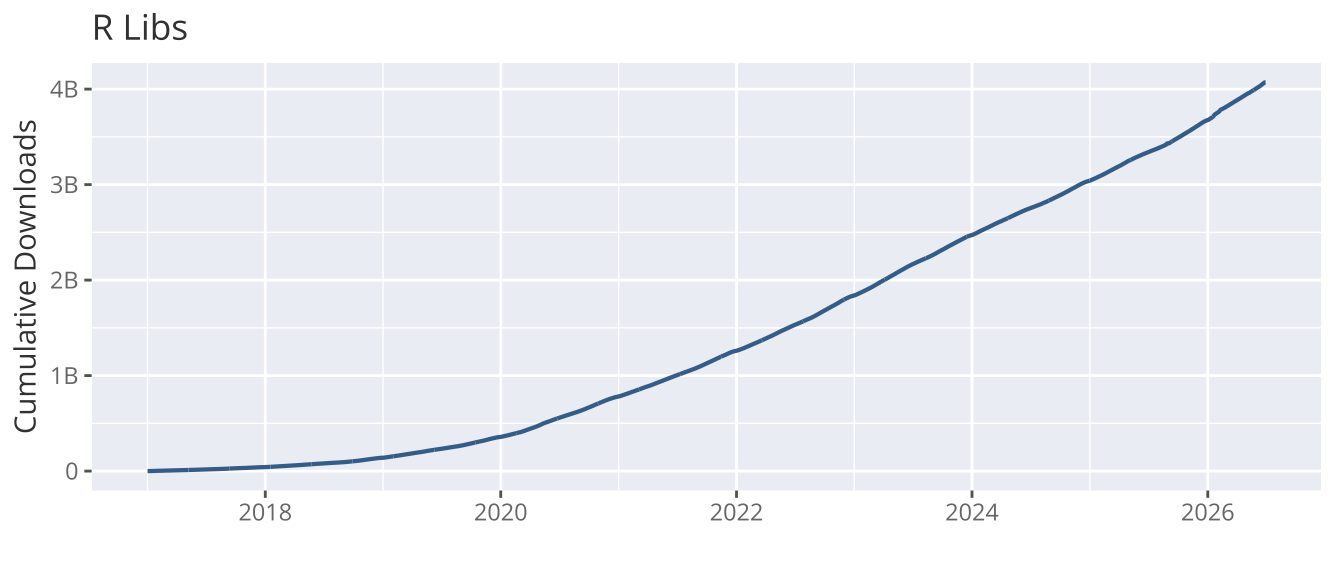
R Infrastructure Tools (r-lib)
R-lib is a large collection of R packages that make it easier to build, find, and use effective tools for data analysis.
There are currently 114 R-lib packages. Popular packages include devtools, testthat, roxygen2, pkgdown and usethis.
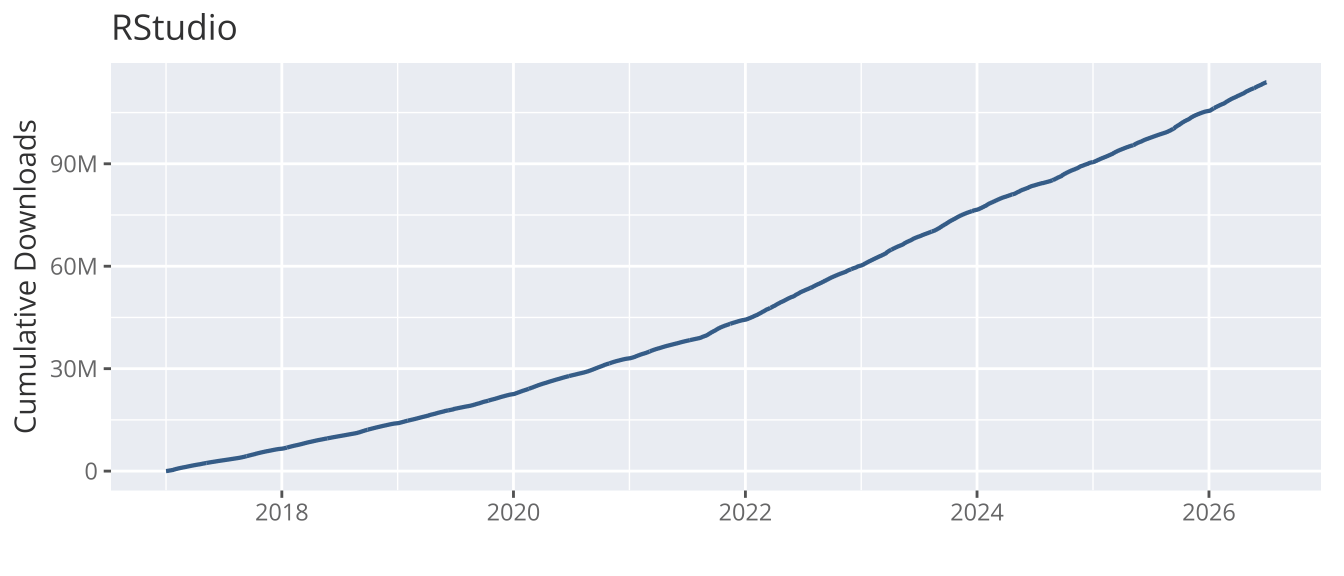
RStudio Integrated Development Environment
RStudio is a multi-language IDE designed for data science with R and Python. It augments the standard code console with an editor that can display Notebooks, launch apps, highlight code syntax, spot code errors, and directly execute code. Built into the IDE are tools for debugging, plotting, browsing files, and managing project histories and workspaces. Together these tools make data scientists and developers much more efficient.
There are 5 FTE Posit employees developing the RStudio IDE open-source desktop and server products as of May 2026.
Positron
Positron® is a multi-language IDE designed for data science. Positron has first-class, built-in support for R and Python via an integrated console, with extensibility options for other languages. This native support includes specialized views and panes throughout Positron such as a Data Explorer, Connections Pane, Variables Pane, access to Posit AI, and more.
Positron separates the language interpreter from the IDE. If R or Python crashes, the IDE keeps running. This design also lets users switch between language versions without reloading the IDE. The R side is powered by Ark, an open source R kernel, and Positron ships with Air, a fast R formatter. Both are written in Rust.
Positron is built on Code OSS and supports VS Code compatible extensions (.vsix files). Building on Code OSS gives Positron a capable text editor and access to thousands of community extensions.
Additional languages typically used in package development are supported via existing third party extensions. These don’t make use of the full Positron data science experience including an interactive console, plots, and similar. Some examples include Rust, Javascript/Typescript, C/C++, or Lua.
Positron is licensed under the Elastic License 2.0, a source-available license. Read more about what this license means and our decision to use it.
Positron is built specifically for data science, not as a general-purpose editor like VS Code.
Positron has added several notable features since its first stable release. A native Notebook Editor brings the IDE’s tools to Jupyter notebooks. Posit Assistant adds AI assistance throughout the IDE, including inside notebooks. A new Packages pane shows what is installed, attached, and out of date.
Positron reached a stable desktop release in August 2025 and now ships monthly updates, most recently version 2026.06. It runs on Windows, macOS, and Linux.
There are 16 FTE Posit employees developing Positron as of May 2026.
Posit Public Package Manager
With the ubiquity of open source software in our daily lives, one area that most people don’t think about is ‘How do you distribute that software quickly and securely to the end user?’. To that end, Posit created Posit Package Manager, which gives companies a means for providing curated repositories, repository snapshots for better reproducibility, the ability to air-gap the repository for enhanced security and much more.
As part of our commitment to improving the quality and availability of open source software for all, Posit hosts a public instance of Posit Package Manager called Posit Public Package Manager that mirrors CRAN, PyPI, Bioconductor and OpenVSX. This mirror serves over 74 million downloads per month (as of Q2 2026).
B Lab® Impact Assessment Results
The B Lab’s Version 1.6 Impact Assessment is composed of questions in five Impact Areas: Governance, Workers, Community, Environment, and Customers. Posit’s assessment results are available to the public here. We completed our first Impact Assessment in 2019 and earned an overall score of 86.1. We completed our first recertification in 2023 and earned a score of 92.5. To put this in context, the threshold for B Lab certification is a score of 80 or higher, and the median score for ordinary businesses who take the assessment is 50.9. Posit seeks to continually improve our internal governance, increase our workforce diversity and employee development efforts, offset our carbon emissions, deepen our engagement in our communities, and better serve our customers so that our public benefit will continue to improve each year.
In our initial assessments, we received high marks for incorporating as a benefit corporation, the health, wellness, safety, and financial security of our employees, and for educating and serving customers.
Summary of 2023 Score
| Impact Area | Score |
| Governance | 17.7 |
| Workers | 32.5 |
| Community | 15.4 |
| Environment | 4.4 |
| Customers | 22.4 |
Community
Civic Engagement and Giving
In addition to the open-source software we make freely available, and the open source data science package development produced by Posit engineers, Posit recognizes the importance of contributing financially to other valuable open-source and community initiatives. In December 2024, we joined the Open Source Pledge, committing to invest at least $2,000 per developer each year in open source, a floor we’ve comfortably exceeded. To date, Posit has given over $3.3M to projects led by others. Current commitments include contributing to NumFOCUS, the R Consortium, the R Foundation, DuckDB, the Eclipse Foundation, and the authors and maintainers of several other open-source projects. In June 2026, Posit joined the Jupyter Foundation, helping fund the core infrastructure, release engineering, and community events its ecosystem depends on.
Posit’s financial support also extends beyond the world of open source data science. Since 2020, Posit and its employees have given over $107k to over 220 nonprofits. Our donations reach a range of community-based causes, including organizations dedicated to racial equality, equal justice, LGBTQ+ support, and access to education. Alongside our donations to open source software development, this pool of charitable contributions contributes to the important work many are doing to increase the accessibility of data science for all. Our scoring in this area of the B Lab assessment has increased by 39.5% since 2019.
Diversity, Equity, and Inclusion
Posit continues to focus on increasing the strength of our team by utilizing talent practices that encourage diverse people to apply, join, and thrive at Posit. Specific changes made in recent years include the formation of a diversity, equity, inclusion, and accessibility council (DEIA Council), as well as the sponsoring of employee resource groups (ERGs). We also pay close attention to issues of equity in compensation, hiring and interviewing, and employee experience.
Customers
We have made meaningful improvements in our care for customers in the past few years – particularly in our standards for managing customer data and privacy. Since 2019, we have formalized our approach to data privacy and compliance – we now conduct thorough internal and external audits and train all employees on the essentials of guarding customer data.
Governance
A company’s positive governance impact is measured by the extent to which the company is accountable to stakeholders, and the extent to which its decision-making is transparent to all constituents.
We’ve made improvements in ethics and transparency areas, including anti-corruption and code of ethics training for employees, and more rigorous financial controls and financial transparency with employees. Looking ahead, we plan to incorporate more social and community benefit metrics in our corporate reporting, including board meeting updates, so that all of our stakeholders are aware of our ongoing progress and can help support our success.
Workers
Investments in employee career development include in-house management training programs, tooling and education to support constructive feedback, and documentation of job levels, pay ranges, and career paths within our major functions. In 2021, we initiated an annual organizational health survey, which allows us to collect and respond to employee feedback. We have also augmented our benefits to include a “lifestyle savings account” (LSA) funded by Posit that each individual can choose to apply to home office, professional development, wellness, or financial health expenses as they see fit. All together, we are working to continuously improve the value offered to our workers as our company grows.
Environment
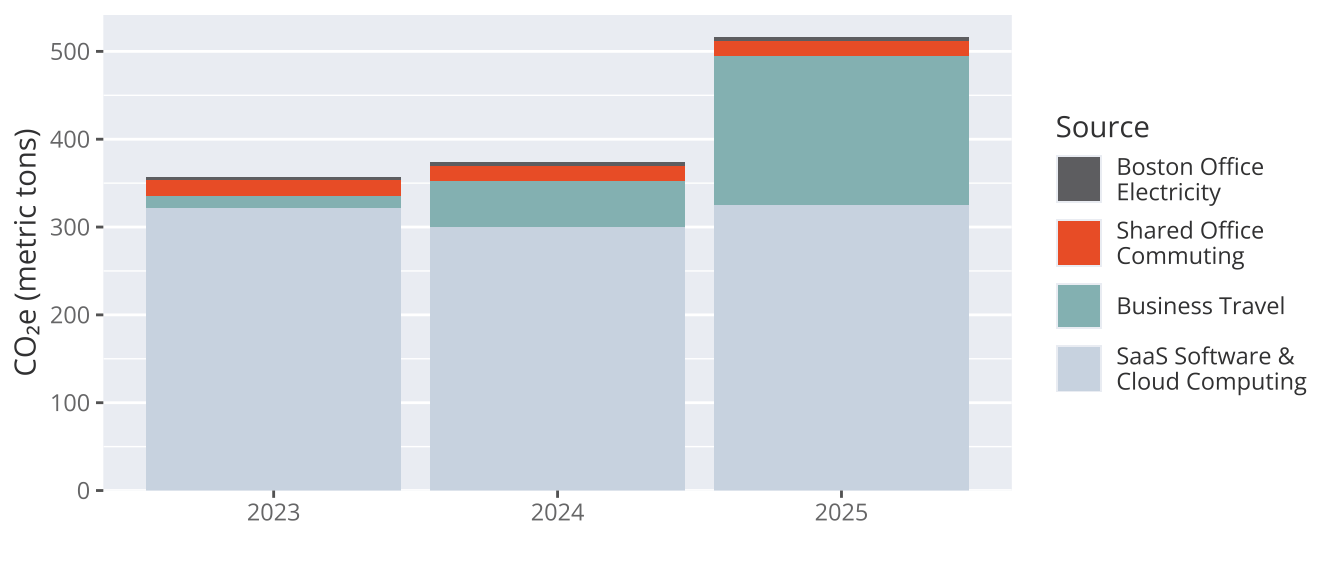
As a remote-first organization, we do not generate meaningful greenhouse gas emissions. However, for the emissions we do generate from cloud computing, business travel, and our Boston headquarters we purchase carbon offsets to achieve carbon neutrality. We first achieved carbon neutrality in 2020 and have since maintained our neutrality by purchasing carbon offsets for years 2021 - 2025. Below is a breakdown of our scope 2 and scope 3 greenhouse gas emissions from the past three years. We track our emissions so that we can purchase an equal amount of carbon offsets. We direct our purchases of carbon offsets towards Nature-Based Removals like reforestation and Technology-Based Removals like Direct Air Capture.