Hangout with Your Colleagues: The Secret to Building Engaging Internal Communities



We invite you to also join us August 5th for our fireside chat with three leaders from Gen Re, Boehringer Ingelheim, and Bank of England on Building Engaging Internal Data Communities. Sign Me Up!
Why are communities at work so important?
It’s easy to get siloed and stay tucked away within our specific departments at work, but the best ideas and breakthroughs often come from casual conversations with people in “hallways” - not from having our noses buried in our own code. Hallway moments across departments don't always happen naturally, but internal communities can help to bridge that communication gap.
Communities help us discover new capabilities, connect with others, solve problems faster, and ultimately…feel happier. They help us get unstuck and prevent us from reinventing the wheel. Working within data science communities has shaped our careers here at Posit, and we’ve seen firsthand how they can be the "secret sauce" of analytics maturity. (Even Gartner analysts say so 😉).
Sounds amazing, right? In reality, fostering a community isn’t easy, especially since it’s rarely anyone’s full-time job. Before overthinking it, we believe the most important thing you can do is simply get people talking. Here’s one way we did that.
“Just” get people talking
This month we're celebrating 5 years of the Data Science Hangout, which is held every Thursday at 12pm ET. There are no slides and no formal presentations. Instead, it’s an open conversation with a different featured data science leader each week, and it’s entirely shaped by Hangout attendee questions (with a few from our host, Libby, to get things started!).
We’ve hosted plenty of in-person and virtual meetups in the past, and as much as people enjoyed the speakers and presentations, what they really wanted was space to talk to each other. The magic was happening in the Q&A or the hallways after the presentations.
People have become genuine friends through attending Hangouts. They’re in the chat sharing resources, posting job openings, and helping each other solve problems in real time. This open, no-slides, conversation-forward format has really helped everyone’s barriers come down!
Want to start your own? Steal our format
The beauty of the Hangout is its simplicity. It is a virtual call (Zoom, Teams, etc.) held on a consistent schedule. We do it weekly, but that might look different for you.
Each session could feature a different "data person" from across your company. The goal isn't to watch them demo a dashboard, it’s to ask them about their journey, their best practices for stakeholder communication, how they navigated a specific organizational hurdle, or whatever else is top of mind for your colleagues!
You might think another meeting is the last thing your team needs. We hear you! But an internal "Hangout" is more community conversation, less meeting. The benefits can include:
- Cross-pollination: It brings together people who wouldn’t normally cross paths, helping the organization solve problems faster.
- Peer learning: Data scientists can see how other teams are handling communication, tool access, and deployment without a formal "training" session.
- Low-stress for speakers: Unlike a "Lunch and Learn," there are no slides and no prepared presentations. The featured guest just shows up to have a conversation.
4 lessons from 220+ community events
Running a successful community event is a marathon, not a sprint. Here are the core pillars we've leaned on to build a welcoming, safe space.
Lesson 1: Start Small to Build Your Culture
Don't worry if only 5 people show up at first. A small group allows for deeper connections and helps establish the "vibe" that you want.
Pro tip: reach out to people 1:1. Asking for volunteers feels easier, but reaching out to individuals 1:1 to ask them for help or to be a featured guest is the way to go. Ask for specific things by specific deadlines, and then follow up.
Lesson 2: Consistency is Key
It’s better to be monthly and reliable than weekly and sporadic. Consistency helps build familiarity and trust. Even if people only attend once a month, they appreciate knowing the community is there whenever their schedule clears. Don’t try to satisfy everyone’s schedules (it will never happen!).
Speaking of consistency: you need a chat channel. It needs to be something that everyone at work can access easily, will use, and won't disappear over time. Does your company use Teams? Slack?
Lesson 3: Standardize to Save Your Sanity as an Organizer
To avoid community organizer burnout, standardize what you can so you can use more of your brain power on people, not process. Here are a few things we’ve standardized over time. Don’t worry if you don’t have all of these things right away.
- Intake form: Use a simple form to collect speaker bios, photos, topics of interest, etc. and make sure it’s a form that people at your organization have access to.
- Script: Have a 60-second "Welcome" intro to ground the session every week and let people know how to interact, ask questions, etc.
- Recurring event: Set one recurring meeting for the community event so that you don’t have to repeatedly invite people to events. It will already be up and running for you for the next one.
- Maintain a schedule: When inviting a featured guest, streamline the scheduling by offering two specific, upcoming dates for them to select from. Providing sufficient advance notice increases the likelihood of them accepting, which in turn helps you consistently fill your event calendar.
- Stay flexible: Overly prescribed agendas can lead to people being “afraid to break the rules,” which leads to less participation. If people are talking to each other, the goal of community is being achieved. If they’re enjoying themselves, don’t worry too much about “staying on track” unless you’ve promised a speaker a certain amount of time and you’re in danger of running over.
Lesson 4: Every Week Might Be Someone’s First Time
Start each meeting with the expectation that someone there has never been there before. It’s great when you have regulars, but most likely not everyone will join every single one!
Explicitly state that all are welcome, regardless of experience level. Remind people they can 'listen in' without feeling pressured to speak, that they can ask questions anonymously, or that they can choose just to engage in the chat. We find people are more likely to check out an event if they know they won’t need to participate publicly right away.
Here's your checklist to get started:
- Put something on the calendar: Find a recurring slot and stick to it. Weekly or monthly works great.
- Recruit your first 2 speakers AND ~5 attendees: Reach out to colleagues in diverse roles and ask: "Would you be open to building this new community format with me?" Your early attendees will help build the group and culture along with you.
- Offer anonymous engagement: Give people a way to ask questions anonymously. Slido has a free tier that lets you do this.
- Recognize your attendees: Thank a few people 1:1 after each event for joining and ask for their feedback. You can learn a lot just by reaching out to say, “Great to see you at the Hangout today!”
- Follow up: Share the recording and 2-3 "top takeaways" in a Slack or Teams channel afterward. This keeps the momentum going for those who couldn't make it.
And join us on August 5th!
Building an internal data science community is one of the highest-leverage things a team can do. It spreads knowledge, reduces risk, and creates the kind of culture where great work actually gets seen. But it's also hard to know where to start…or how to keep the momentum going.
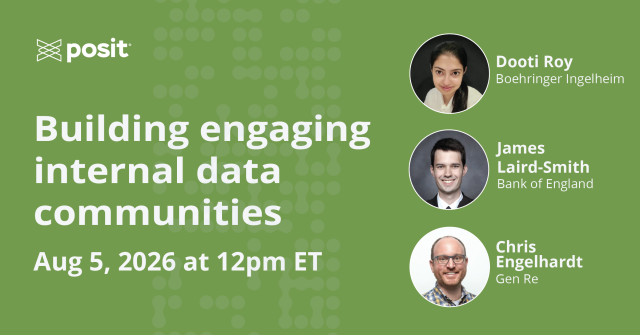
On August 5th at 12pm ET, Libby Heeren at Posit is leading a fireside chat with three community leaders who will share what they've built at their organizations, how they did it, and what they'd tell someone just getting started. Join us with:
- Chris Engelhardt - Vice President, Head of AI Services at Gen Re
- Dooti Roy - Executive Director, Head of Innovation at Boehringer Ingelheim
- James Laird Smith - Senior Data Scientist at Bank of England
You'll come away with practical ideas you can act on. Can't make it live? Register anyway and we'll send you the recording.

Rachael Dempsey
