Posit Assistant: AI That Sees Your Data, Code, and Visualizations for Reproducible Analysis


Posit Assistant is an AI data analysis assistant built into Positron, Posit's source-available IDE for R and Python, that connects to your live session to help you explore data, build reproducible analysis with code, and generate visualizations. It’s also available in RStudio and as a terminal application. Unlike AI coding tools designed to help you write software faster, Posit Assistant tracks whether your analysis remains accurate and reproducible as your research and workflows evolve, making analytical trust an ongoing practice rather than a one-time check.
Why Analytical Trust in Data Science Is Hard to Maintain
Data scientists are among the most capable people in any organization, writing code and building models that translate complexity into consequential decisions. But a question follows almost every piece of analytical work, from a simple dashboard to a sophisticated predictive model: can I actually trust this output?
Today's output might be sound, but trust isn’t automatically sticky. It shifts after a data refresh or package update, and again when a new team member inherits the workflow without the context. For most teams, sustaining it turns out to be hard.
Analytical failures can sneak in. A chart gets slightly misread in a board presentation, its conclusions accepted without question; or a report runs correctly in development and fails silently in production. A model may drift gradually toward outcomes nobody intended, the deviation small at first, consequential only later. Traditional tools catch the obvious breaks, but some pass through, hurting you at costly moments.
In life sciences, financial services, and government, quality failures become compliance failures, the consequences reaching beyond the data team. An actuary whose model outputs shift unexpectedly needs to understand why before the regulators ask. A pharmaceutical data scientist needs to know whether summary statistics that shifted after a data transfer reflect reality or an upstream error. Speed matters in these environments, but confidence in the output is what makes the work defensible when a regulator asks to see the reasoning or a constituent relies on service delivery.
What Most AI Coding Assistants Don't Address
The AI coding assistant market has grown quickly, and most tools in it are built for the same purpose: helping developers write code faster. Tools like GitHub Copilot and Cursor helpfully accelerate development, complete boilerplate, and suggest syntax well.
But speed without confidence creates a different kind of problem. Faster code generation does not tell you whether the data you are analyzing is clean. It does not tell you whether the model you built last quarter still behaves the way it did when you validated it. It does not tell you whether the chart on slide twelve reflects the same underlying logic it did when you created it.
Major AI coding assistants currently fail to observe all three. Most operate entirely in the text layer, ignoring your data and outputs.
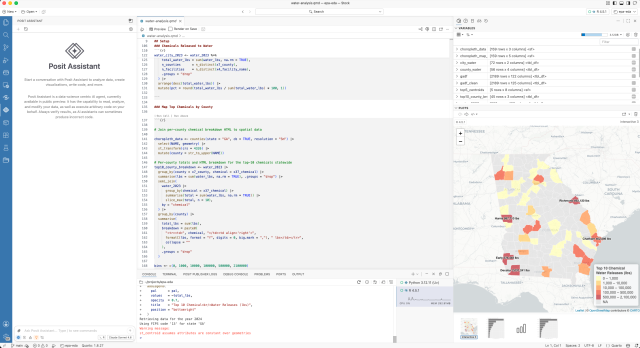
Posit Assistant in Positron
How Posit Assistant Sees and Improves Your Data, Your Code, and Your Visualizations
Posit Assistant is built into Positron and RStudio and operates across three distinct layers of your analytical workflow simultaneously. The combination produces a kind of awareness that no single-layer tool can replicate.
Data layer: catch quality issues before they reach your models
Because Posit Assistant has out-of-the-box access to your R or Python session, you get on-demand visibility into the quality, consistency, and shape of the data your work depends on. It can understand the shape of your dataframes, and has the rich metadata of your notebooks.
Inconsistencies in your data can get flagged before they influence a model. Most problems at this layer go unnoticed until something downstream breaks. With Posit Assistant, you can see and fix the problems upstream.
Code layer: detect changes and keep your workflows reproducible
Posit Assistant can also run code directly in your live session, and it also has specialized prompting, skills, and tools that promote sound data analysis. It helps you detect subtle shifts in your workflows, understand and modernize complex or inherited code, and ensure that what you built today produces the same results tomorrow. It does more than identify what broke by explaining what the change means for the analysis that depends on it.
Output layer: observe how your visualizations change when data or code shifts
Posit Assistant observes rendered plots and charts directly in the Positron and RStudio IDEs, flagging when a visualization changes in ways your data or code changes would predict and when it changes in ways they would not. Other assistants focus on software engineering, operating in the text layer and ignoring your outputs.
What three-layer awareness looks like in practice
Consider a biostatistician working on a clinical trial summary report. A new data transfer arrives from a trial site, changing model outputs. With Posit Assistant, the investigation spans all three layers at once:
- The data layer flags that the incoming dataset has an elevated rate of missing values in a key exposure variable.
- The code layer identifies the downstream script modules affected and explains what that means for the primary endpoint calculation.
- The output layer shows that two charts changed in ways consistent with the data issue, and flags a third chart that changed in a way the data alone would not explain.
What might have taken hours to trace manually becomes understood in minutes, with enough context to act on confidently.
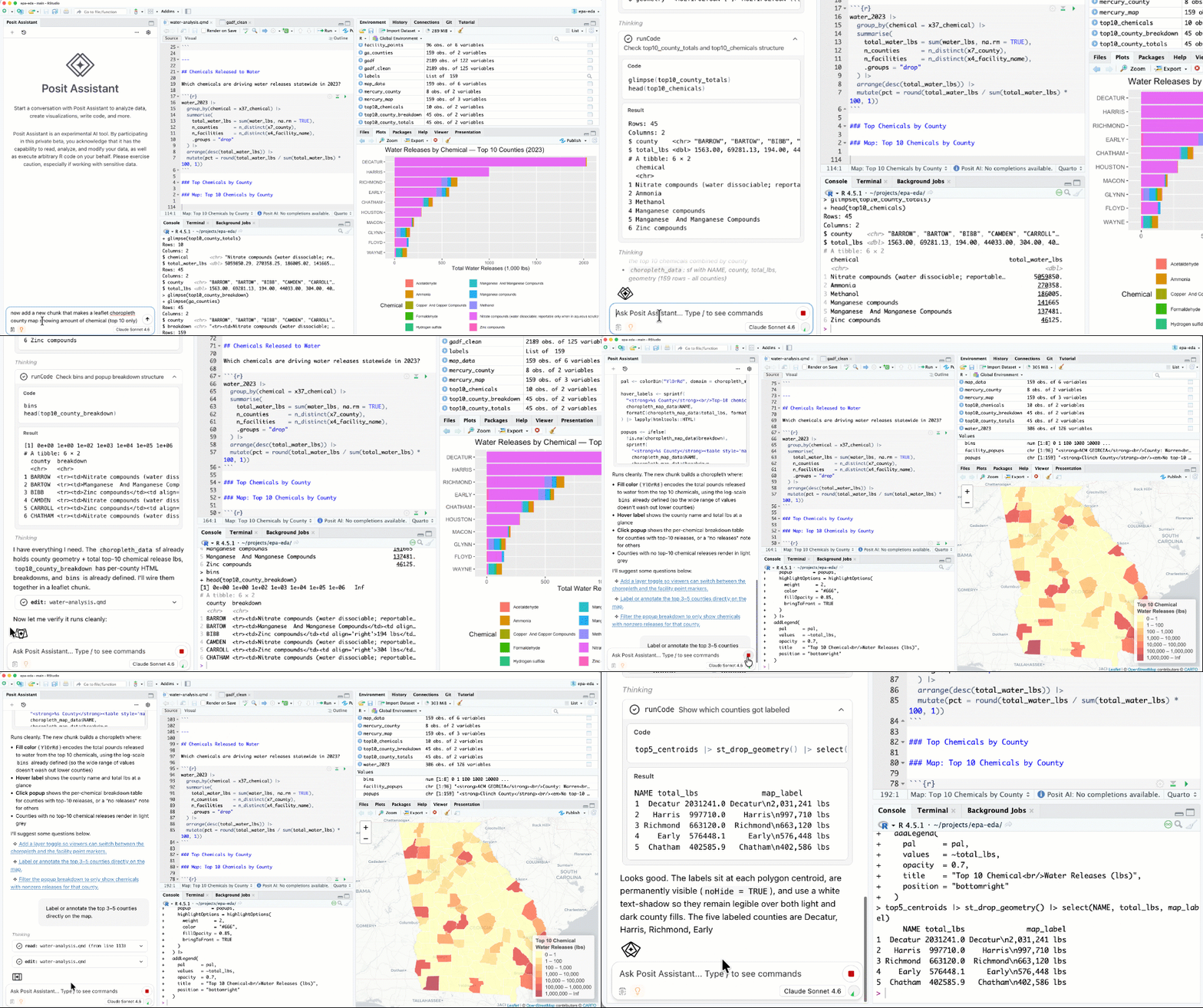
Posit Assistant running in RStudio
Posit Assistant in Pharma, Finance, and Government
Regulated industries share a common analytical requirement: the ability to defend their work under external review. For pharmaceutical companies, that means GxP-compliant workflows, documented at every step from data intake through final output. For banks, it means fraud detection logic transparent enough to explain to regulators. For insurance companies, it means actuarial models that hold up across every policy review cycle. For government agencies, it means public-facing reports that are both reproducible and auditable.
Posit builds on open standards, running your analysis in open-source R and Python with no proprietary language or vendor SDK required. Your code is portable and runs anywhere. Posit Assistant extends that foundation with context-aware oversight, making your data, logic, and outputs visible without pulling workflows into a proprietary system.
How Posit Workbench and Package Manager Extend These Capabilities
Analytical confidence is both a regulatory and business requirement. A tool you can defend matters more than one you simply trust, especially when that defense must hold up under external review.
Posit Assistant in Positron and RStudio delivers three-layer awareness for individual analysts, whether they are working on a local machine or a remote desktop session. For teams operating in regulated environments, Posit Workbench and Posit Package Manager extend that capability to the organizational level.
Posit Workbench adds the server-side infrastructure that turns individual analytical awareness into organizational governance. Session logging, centralized access controls, role-based permissions, and the ability to run Positron Pro and RStudio Pro at scale in secure environments gives IT and compliance teams the visibility they need without disrupting the workflows data scientists rely on. When Posit Assistant flags an issue in a Workbench-hosted session, the context is preserved and traceable in ways that desktop-only tools cannot match.
Posit Package Manager closes the reproducibility gap that Posit Assistant can detect but cannot prevent on its own. Posit Assistant can tell you when package versions have drifted and explain what that means for your analysis. Package Manager ensures the drift does not happen: date-based repository snapshots, curated package sets, and pre-built binaries mean the packages your team depends on today are the same ones your analysis runs on next quarter, across every machine in your environment.
Package Manager also governs AI assistants. Its Model Context Protocol (MCP) server gives AI coding assistants, including Posit Assistant, structured access to your organization's curated package repositories. When an AI assistant suggests a package, that suggestion is grounded in what is actually available and approved in your environment, not just whatever is on CRAN or PyPI. In air-gapped and regulated environments where unvetted packages are a compliance risk, this is the governance layer that makes AI-assisted development trustworthy rather than just fast. No competing package management tool addresses this use case like Posit Assistant with Package Manager.
Posit Connect governs the publishing layer where that work ultimately resides, scheduling and securing access to the reports, models, apps, and APIs your team deploys to stakeholders so that validated analysis travels through the same governed infrastructure from development to delivery.
Together, Positron and RStudio, Posit Assistant, Workbench, Package Manager, and Connect cover the full scope of analytical trust whether you are an individual analyst catching an anomaly in a chart, or an IT team governing who runs what in a validated environment, or a compliance officer demonstrating that the analysis your team produced six months ago is reproducible today, or the stakeholder receiving a report they can trust.
The Big Picture
AI tools are proliferating quickly, and most of them are built to help you write software faster. But speed without confidence creates a different kind of problem in data science and research. Posit Assistant offers the ability to move quickly and trust what you produce from your analysis.
By bringing data-layer awareness, code-layer intelligence, and output-layer visibility together in a single assistant inside Positron and RStudio, and by extending that capability to teams through Workbench and Package Manager, Posit has built something that understands your work in ways other assistants cannot. Not just the syntax, but the context. Not just the output, but what changed and what it means.
However, no AI tool replaces the judgment of the trained expert behind the work. The best ones make that expert more confident, more informed, and better equipped to be exactly what they have always been: the last responsible line of defense.
Frequently Asked Questions
What is Posit Assistant and how does it differ from GitHub Copilot? Posit Assistant is an AI assistant built into Positron and RStudio that sees and informs your data quality, code logic, and rendered visualizations simultaneously. GitHub Copilot is a code completion tool that operates in the text layer, helping you write code faster but does not observe your data or your outputs. Posit Assistant is designed for data scientists who need to verify that their analysis is accurate and reproducible, not just that their code compiles.
Does Posit Assistant work with both R and Python? Yes. Posit Assistant works across both languages. You can ask about data quality issues, code logic, or visualization changes regardless of whether the underlying code is R, Python, or a mix of both.
Can Posit Assistant analyze charts and plots, not just code? Yes. Posit Assistant can observe rendered plots and charts directly in the Positron and RStudio IDEs. It can flag when a visualization changes in ways consistent with an upstream data or code change, and when it changes in ways that are not explained by the changes it can see. This output-layer awareness is not available in other AI coding assistants.
How does Posit Workbench extend Posit Assistant for teams in regulated industries? Posit Workbench adds server-side governance to the individual-level awareness Posit Assistant provides: session logging, access controls, centralized management, and the ability to run Positron and RStudio at scale in secure environments. For teams in pharma, finance, or government who need to demonstrate compliance, Workbench provides the infrastructure layer that turns Posit Assistant's analytical visibility into organizational accountability.
How does Posit Package Manager support reproducible analysis? Posit Package Manager lets organizations host curated R, Python, and VS Code package repositories with date-based snapshots, pre-built binaries, and installation controls. The package environment your analysis depends on today can be reproduced exactly next quarter or next year, across any machine in your environment. Posit Assistant can detect when package drift has occurred. Package Manager can prevent it. Package Manager also includes an MCP server that gives AI coding assistants structured access to your curated repositories, so AI-generated code suggestions are grounded in the packages your organization has approved.
Where does Posit Assistant run, on a local machine, in Posit Workbench, or both? Posit Assistant runs inside Positron and RStudio, which are available as desktop applications and as session types within Posit Workbench. Individual analysts can use it locally, and teams in enterprise environments can access it through Workbench-hosted sessions with full organizational governance in place.

Matt Wallace
Related Content

Introducing usage and performance metrics in Posit Connect Cloud

R, meet Snowflake: Introducing Posit’s skiLift and skiPatrol Packages
