Secure sharing on Connect Cloud: SOC 2 Type I and new OAuth integrations


From the beginning, we set out to make Posit Connect Cloud a secure platform for rapidly sharing R and Python data science work. This means fast sharing of an internal dashboard, a gated report for a client, or a public-facing app for broad dissemination of insights.
The goal was to make the hosting and infrastructure part easy, so our users could focus on developing and delivering work. This includes the core security features that address the most critical vulnerabilities associated with cloud hosting and sharing with different types of users. That work spans the managed platform itself, with protections like encryption at rest, controls over who can access your content, like single sign-on (SSO) and role-based access controls (RBAC), and sharing options built for private, gated, and public audiences.
We're proud to continue this work we've done for the last couple of years with the completion of our first SOC 2 audit and the release of OAuth integrations that bring viewer-level data permissions to shared content. Here's a quick look at how we got here, and what the new additions do.
The story so far
When Connect Cloud launched in July 2024, publishing was intentionally simple and all sharing was publicly available. Since then, we've added capabilities for data access management, secure external sharing, and content management for organizations. By the end of that first year, paying users could deploy from private GitHub repositories and share content through private links, each carrying a unique, revocable token. If a link ended up somewhere it shouldn't, you could cut off access without disabling the underlying content.
In 2025, we launched what's now the Enterprise plan to help teams share and manage data science work across a growing set of users and audiences. Enterprise single sign-on means viewers authenticate through the identity provider your company already trusts. Role-based access control, at both the account and content level, lets you support a wider range of audience types while keeping permissions aligned with the governance rules your organization already follows. Email-authenticated sharing for internal and external audiences made gated sharing fast and empowered you to cleanly define who can get in, whether they sit next to you at work or are an external client.
Earlier this year, custom domains arrived with managed TLS. Your public and client-facing content can live on a web address you own, and Connect Cloud handles the SSL certificates, so connections stay encrypted without anyone babysitting renewals.
Underneath all of it sits infrastructure that Posit hosts and maintains for you, with protections like account-based isolation and built-in encryption at rest. The idea has stayed the same throughout: you focus on the work, and we carry the operational and security load.
Announcing our SOC 2 Type I attestation
Connect Cloud has now also completed a SOC 2 Type I audit and received its attestation report.
SOC 2 is an auditing framework from the AICPA, built for service providers that store customer data in the cloud. An independent auditor examines a company's security controls and attests that they're designed to protect customer data. It has become the standard way for cloud platforms to show, rather than say, that they handle data responsibly.
That's why it matters here. Connect Cloud hosts your applications and documents, along with the credentials and data behind them. That's a responsibility we take on for every publisher, and the attestation means an independent auditor has verified the controls behind it. If your organization runs vendor security reviews, a SOC 2 report is often the first document your security team asks for, and now we have one to hand them. Reports are shared on request rather than posted publicly, so visit the new Posit PBC Trust Center if you'd like a copy.
Having completed our SOC 2 Type I audit, we're now working toward Type II attestation, targeted for Q1 2027.
New: OAuth integrations for viewer-level data access
We've also added OAuth integrations to the Enterprise plan. This enables Connect Cloud to securely access your data sources for a piece of content on behalf of each viewer, using that viewer's own credentials. Here's the problem that solves.
Say you build one Shiny app on top of sales data in Snowflake, and regional managers should each see their own region and nothing else. Until now, your options were awkward. You could build and maintain a copy of the app for every region. Or you could connect through a shared service account with broad data access and write your own filtering logic, which your data governance team has probably never reviewed.
OAuth integrations remove that tradeoff by bringing viewer-based authorization to your content. Setup is three steps, and depending on your team, they might all be one person's job. A one-time registration in your data platform produces a client ID and secret; someone with admin access on your Connect Cloud account enters those under Admin > Integrations; and publishers attach the integration to their content. No infrastructure project required.
From then on, each viewer consents and signs in to the data provider with their own credentials the first time they open the app, and Connect Cloud handles acquiring and refreshing the short-lived access tokens. The data platform applies its own row-level policies to every query, so each viewer gets a personalized view of the data through a single, shared app.
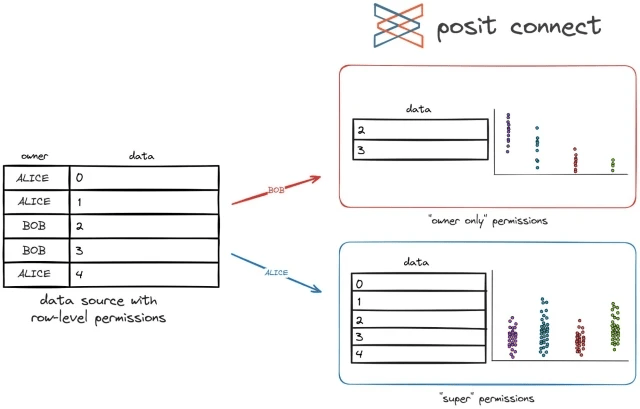
There's a distinction here worth pausing on. Sharing controls decide who can open your content, and Connect Cloud has supported these for a while. Data-level authorization decides what each viewer sees once they're in. Those are different problems, and the second one belongs to your data platform, where your governance team already manages permissions. With these integrations, the app doesn't decide what data a viewer sees; your data platform does, exactly as it's been configured to.
Viewer-level integrations are available for AWS, Azure, Databricks, Google, Snowflake, and Supabase. In your code, you exchange the viewer's session token for a data-provider access token using the connectapi package in R or the posit-sdk package in Python. The documentation includes working Shiny examples for both languages.
Where this leaves us
Connect Cloud today is a place where you can publish R and Python work and share it the way the work demands. Privately within your entire organization, gated to specific clients, or openly with the world. The security controls behind that have now been independently examined, and new OAuth integrations provide Enterprise users with greater control at the data source level over who has permission to see what.
There's more we want to do, and we'll keep sharing the reasoning behind each step as we go. In the meantime, if you've been looking for a secure way to share your data science work in the cloud, Connect Cloud has plans for individuals and organizations, from a free tier for personal projects, through the Advanced plan for teams, to the Enterprise plan with SSO for organizations with greater security demands. Find the one that fits with how you want to deploy and share.

Alex Chisholm

Chris deMontmollin
Related Content

Introducing usage and performance metrics in Posit Connect Cloud

R, meet Snowflake: Introducing Posit’s skiLift and skiPatrol Packages
