2026 Posit Impact Awards


Announcing This Year's Winners:
Earlier this year, we launched the Posit Impact Awards to celebrate more of the incredible work happening across our community. We asked for stories of measurable, meaningful change. For us at Posit, we get to hear about a lot of this work in conversations with customers, but we don't always get the chance to let it shine publicly.
We were so impressed by the response. Submissions came in from individual contributors, academic labs, government agencies, nonprofits, Fortune 100 companies, and national health ministries, spanning the United States, Chile, New Zealand, South Africa, Italy, Germany, and Switzerland.
After a lot of review and deliberation from our panel of 11, we announced eight Posit Impact Award winners at posit::conf(2026). There were so many great stories in the nominations as well, which we hope to highlight throughout the year ahead.
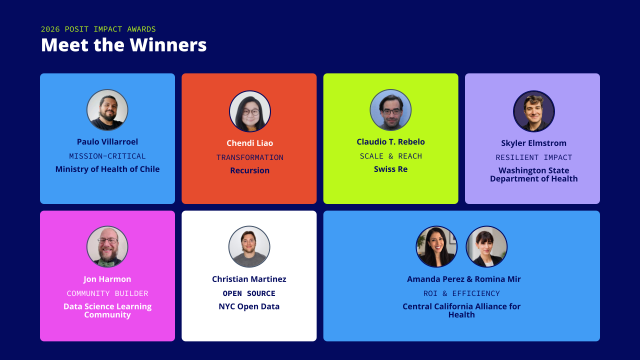
Mission-Critical Impact: Paulo Villarroel Tapia, Ministry of Health of Chile
Paulo used R, Positron, and Quarto to build a system for Chile's Ministry of Health that reads clinical records every month (roughly 450,000 of them) looking for patients whose notes signal cancer suspicion. Those records were always there, buried in free text. There was just no way to systematically find the people in them.
Paulo's model, a three-layer R classifier combining clinical heuristics and semantic embeddings, changed that. It now feeds policy-grade evidence across all 29 of Chile's health services, and it's already surfacing which regions get patients into surgery faster and which don't. Those findings became the foundation of Chile's 90-Day Oncology Plan, launched this past March.
The model flags; it never decides. By design, the clinical decision is made by local clinical teams in every case. Paulo shared with us, "It's also reliable when it rules a case out: of more than 85,000 discarded cases that local teams have reviewed, fewer than 1 in 100 turned out to be cancer (a negative predictive value of 99.3%)." The number that stuck with our panel: the 3.9% of the waitlist this model flags carries about seven times the mortality of everyone else (roughly 48 deaths per 1,000, compared to 7).
Posit products: Positron, Quarto
ROI & Efficiency Champion: Amanda Perez & Romina Mir, Central California Alliance for Health
By 2025, the Central California Alliance for Health was facing a real backlog problem. Dispute volume had jumped from about 1,700 cases a month to over 3,000, with no new staff to handle it. Every case took roughly 55 minutes of manual digging across five-plus systems, and cases got worked in the order they landed regardless of complexity. Median time to close had crept up to 56 business days. On-time compliance had fallen to 17.5%, against a 95% regulatory target. Providers running clinics on thin margins were waiting weeks longer than they should have to get paid.
Amanda Perez and Romina Mir built an end-to-end dispute resolution platform with Shiny and Quarto on Posit Workbench and Posit Connect that replaced that 55-minute manual hunt with one pre-assembled view. An ML model now scores every open case and explains its reasoning. Two Shiny apps handle the day-to-day: one for managers, one for the people doing the case work.
The results speak for themselves: median close time dropped to 20 days, on-time compliance climbed to 77% (93% for claim inquiries), and monthly closures nearly doubled. The same 12 coordinators are now doing what would've taken about 45 people before, the equivalent of adding 33 full-time employees. The project also won first place in the company's own Continuous Quality Improvement Program, with providers getting paid weeks faster and an estimated $1.5 million in annual savings.
Posit products: Posit Workbench, Posit Connect, Shiny, Quarto
Scale & Reach: Claudio Torpes Rebelo, Swiss Re
Swiss Re has invested in analytical capability for years, and a significant amount of actuarial work there is already carried out in R and Python. The challenge Claudio, Model Validation Actuary at Swiss Re set out to solve was not a shortage of advanced analytics. It was access: making capability that already existed easy to reach, for colleagues who code and colleagues who do not.
His instinct wasn't to build a shinier dashboard and ask people to switch over, he'd watched that fail before. Instead, he met people where they already worked: Excel. He put his R and Python logic behind an API, publishing it from Posit Workbench to Posit Connect, then wrapped it in an add-in simple enough that no one needs a manual to use it.
The first real test was Swiss Re's Internal Capital Adequacy Model Toolbox, which reviewers use to run convergence tests on the model. One colleague who'd never written code learned to run an R-based test and pull ggplot2 visualizations straight into her spreadsheet, in under ten minutes. That was enough to convince others across the team to adopt the framework. And because the logic lives on the server rather than in anyone's individual workbook, one fix updates every version of it at once. The same endpoint also works from SAS, Power BI, or Shiny, so the work reaches wherever people already are.
Posit products: Posit Workbench, Posit Connect, Posit Package Manager
Learn more from Swiss Re
Transformation Story: Chendi Liao, Recursion
At Recursion, running early-phase dose-escalation trials means a safety review committee has to meet after every few patients to decide whether to escalate, hold, or lower a dose. That decision used to wait on a reporting process that took up to 10 business days. Raw data was extracted from the Electronic Data Capture (EDC) system, processed in R, and rendered into static documents: PDFs or HTML files distributed through email and/or Google Drive. Reviewers would ask follow-up questions and late-entering data points would shift the picture, but the moment a file left the analyst's hands, the aging process began.
Chendi Liao and her team at Recursion rebuilt the whole workflow with Quarto and Posit Connect. Analysts now pull data straight from Recursion's clinical data storage in Posit Workbench and publish versioned, real-time reports that are ready the moment the committee sits down. Three analysts now support five or more active trials, work that would've needed roughly triple the headcount the old way.
The impact is most visible in dose escalation reviews with a 7x cut in data-to-decision time, from 7–10 business days down to 24–48 hours.
Posit products: Posit Workbench, Posit Connect, Posit Package Manager, Quarto
Learn more from Recursion
Community Builder: Jon Harmon, Data Science Learning Community
In Jon Harmon’s own words, “Many people come to data science sideways, and it isn't always clear what to learn, let alone how to do so.” He wanted to make it as easy to learn about data science as it could be.
Over the past 8 years, Jon has grown the Data Science Learning Community (on Slack, GitHub, and social media) as a welcoming place where people share learnings, ask questions, join together in book clubs, and discuss how they work with data. Jon truly models the behavior he wants to see in a community and has personally welcomed ~5,000 DSLC members to establish and strengthen the overall friendly "vibe" of the community.
Through his community work, the DSLC has grown to 23K+ Members on Slack, has hosted 100 book clubs, over 2,000 weekly discussions, and much more.
Posit products: Positron, RStudio, Posit AI, Shiny, Quarto
Join the Data Science Learning Community
Open Source Contribution: Christian Martinez, NYC Open Data
Christian noticed something frustrating about his data science courses: students did real work, turned it in, got a grade, and that was it. The work had no life after the semester ended.
He built nycOpenData, an R package that makes it easy to pull from thousands of continuously updated NYC Open Data datasets, and rebuilt his curriculum around it. Now students publish their analyses in a public research gallery on Posit Connect Cloud, build portfolio books out of their weekly assignments, and some have gone on to contribute to the package itself. It passed open peer review, joined the rOpenSci ecosystem, was published in The Journal of Open Source Software (JOSS), and has grown into a family of packages covering other cities. This year, every grad student in Christian's course presented their research at NYC Open Data Week, many of them for the first time.
Over 10 billion rows of city data have now been made available, enabling student projects with lasting value. For Christian, this changed how he thinks about teaching. Rather than measuring success by completed assignments, success is now measured by what students create that continues to benefit others.
Posit products: Posit Connect Cloud, Shiny, Quarto
nycOpenData package
Resilient Impact: Skyler Elmstrom, Washington State Department of Health
Skyler's team at the Washington State Department of Health brought deep public health expertise, while building newer capabilities in code, Quarto, or automated publishing. At the same time, they needed to produce tailored dashboards for up to 35 local health jurisdictions at once. The early approach, a separate Quarto file for each one, worked fine at first. But as more counties needed their own dashboards, and funding and staffing kept shrinking, maintaining dozens of parallel reports was becoming increasingly difficult.
Skyler built a single parameterized, version-controlled reporting framework using Posit Workbench, Posit Connect, Posit Package Manager, and Quarto, with governed data supplied through Databricks Unity Catalog. Instead of maintaining dozens of separate reports, the team can now use one reusable workflow to generate all 35 dashboards, supporting consistent disease surveillance, health outcome, and population reporting across jurisdictions.
The work also depended on colleagues who were willing to experiment with new tools and change established workflows. Chelsea Barth, Dana Drummond, Angela Kemple, and Jordan Arias were critical to making the approach successful by exploring these tools, adopting them in their day-to-day work, and helping turn the framework into something the team could actually use and sustain.
Public health agencies are facing reduced funding, loss of staff and specialized knowledge, and shrinking technical capacity. This was never just a dashboard modernization or automation project. It is a sustainability strategy: reducing duplicated work, preserving institutional knowledge, and helping critical public health reporting continue under constrained resources.
Posit products: Posit Workbench, Posit Connect, Posit Package Manager, Quarto
We're just getting started
We loved getting to celebrate with many of the winners in person at posit::conf(2026) this year. Our goal is to keep celebrating this wonderful community's work throughout the year.
One way to keep hearing from impactful leaders is to join us at the Data Science Hangout, which happens every Thursday. A few other stories from Impact Award nominees will be featured there in the next few weeks.
If any of this made you think of your own story that you'd like to share, we'd love to hear from you! You can tell us a bit about it here, and Rachael Dempsey from Posit will reach out.

Rachael Dempsey
Related Content

Tiny Doses for Tiny Babies -- How much is too much?

Score a Disease Surveillance Model Inside Snowflake, Without Moving
