Posit Assistant now connects to your Databricks-hosted models (Preview)


TL;DR
- What: Posit Assistant, the AI coding agent built into Positron and RStudio, can now connect directly to models served from your own Databricks workspace through Databricks Model Serving and Unity AI Gateway. Available in preview.
- Why: Prompts, schemas, and data submitted to Posit Assistant stay within your Databricks security boundary, so teams in banking, healthcare, and the public sector get AI-assisted coding without the data-leakage risk that rules out ChatGPT and public model APIs.
- How it's governed: Every Posit Assistant request inherits the Unity Catalog permissions, column-level security, and audit trails already enforced in your workspace, and is covered by Databricks' zero data retention guarantees: nothing logged, stored externally, or used to train public models.
- What it knows: Unlike a browser-based chatbot, Posit Assistant reads your active files, loaded R and Python data frames, plot history, and console output, then writes and runs code directly in your session.
- What it costs: Traffic routes to Databricks serverless or GPU capacity you've already committed to rather than retail per-token API rates, with Unity AI Gateway applying rate limits, budgets, and cost tracking per endpoint.
Table of Contents
- Built on the governance you've already invested in
- An assistant that actually knows your workspace
- Get more from the compute you've already paid for
- The four things this unlocks
- How this benefits your team
- Get started
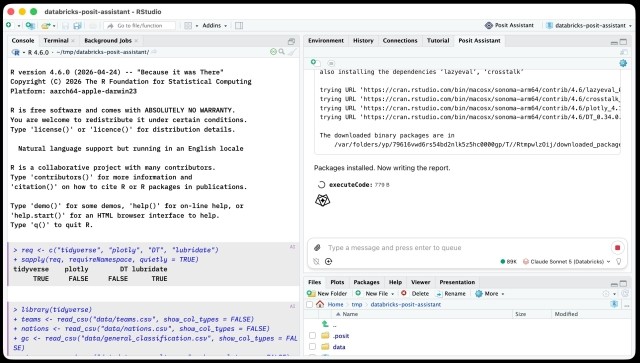
Posit Assistant, the AI agent built into Positron and RStudio, can connect directly to models you already have access to through Unity AI Gateway. For regulated industries like banking, healthcare, and the public sector, this means data scientists get AI-assisted coding without prompts, schemas, or data interacting with external models. Note: this feature is in preview.*
Your data stays inside your perimeter
Many enterprise teams can't use general AI tools, like ChatGPT or a public model API, because of data-leakage risk. By routing Posit Assistant through your own Databricks workspace, the agent interaction remains inside your private cloud VPC. Combined with Databricks' zero data retention guarantees, nothing you send is logged, stored externally, or used to train a public model.
Built on the governance you've already invested in
Most organizations have spent years building access policies, column-level security, and audit trails into Unity Catalog. When Posit Assistant calls a Databricks hosted model, it inherits the exact same permissions and guardrails already enforced within your workspace. Your security team can audit human and agent activity from the same control plane they already use: Unity Catalog.
An assistant that actually knows your workspace
A general-purpose chatbot has no idea what's open in your session. Posit Assistant does; it has context on your active files, loaded R and Python data frames, plot history, and console output. That means no more copy-pasting schemas or data frames into a browser tab: you can ask it to clean a table or build a Shiny app from the columns in front of you, and it writes and runs the code directly in your session.
Get more from the compute you've already paid for
Public LLM APIs bill per token at retail rates, and that adds up fast across a large team. If your organization already has committed spend or provisioned capacity with Databricks, routing Posit Assistant traffic to your own Databricks-hosted foundation models (or a custom fine-tuned endpoint) lets that usage count against spend you’re already paying for, rather than opening a separate bill with an external LLM provider. Databricks’ Unity AI Gateway sits in front of every model request, so you can apply rate limits, budgets, and cost tracking directly on the endpoints Posit Assistant talks to.
The four things this unlocks
- Data sovereignty: prompts and schemas stay inside your Databricks environment, covered by zero data retention guarantees.
- Inherited governance: requests run under the same Unity Catalog permissions already enforced in your workspace.
- Workspace-aware answers: the assistant sees your active files, data frames, and console history for accurate, context aware developer assistance.
- Cost efficiency: traffic routes to compute you've already paid for, with Unity AI Gateway applying rate limits and budgets on top.
How this benefits your team
Data scientists
Spend more time thinking big and building fast, less time coding boilerplate, with accurate, context-aware suggestions grounded in your current session.
IT and security teams
No prompts leaving the private network, and one place to audit every human and agent query.
Enterprise leaders
AI spend consolidates onto the Databricks contract you already have, getting more value out of your existing lakehouse investment.
Get started
If your organization already runs the latest version of Posit Workbench alongside Databricks, your administrator can connect Posit Assistant to a Databricks Model Serving endpoint using individual API keys, following the Posit Assistant setup guide. From there, it works the same way Posit Assistant does everywhere else: right inside Positron or RStudio, wherever your team is already working. Have questions about your specific Databricks setup? Talk to us.
*This feature is in preview. Preview features are unsupported and may face breaking changes in a future release. Any issues found in the feature will be addressed during the regular release schedule; they will not result in immediate patches or hotfixes.
FAQ & Resources
- All about Posit & Databricks partnership page
- Infographic: The Embedded Intelligence Loop
- What is Posit Assistant? Posit's unified AI coding agent, built into Positron and RStudio sessions, with context on your active files, data frames, and console history.
- How does Posit Assistant connect to Databricks-hosted models? Posit Workbench routes requests through your Databricks Model Serving infrastructure, each call inherits the same Unity Catalog permissions already in place.
- Is my data secure when Posit Assistant uses a Databricks-hosted model? Yes. Prompts and schemas stay inside your private Databricks environment under Databricks' zero data retention guarantees — nothing is logged, stored externally, or used to train public models.
- Which Databricks-hosted models can Posit Assistant use? Any model served through Databricks Model Serving, including Databricks-hosted foundation models and custom fine-tuned endpoints, governed by Unity AI Gateway's rate limits and budgets.

Denise Martinez
Related Content

Introducing usage and performance metrics in Posit Connect Cloud

R, meet Snowflake: Introducing Posit’s skiLift and skiPatrol Packages
